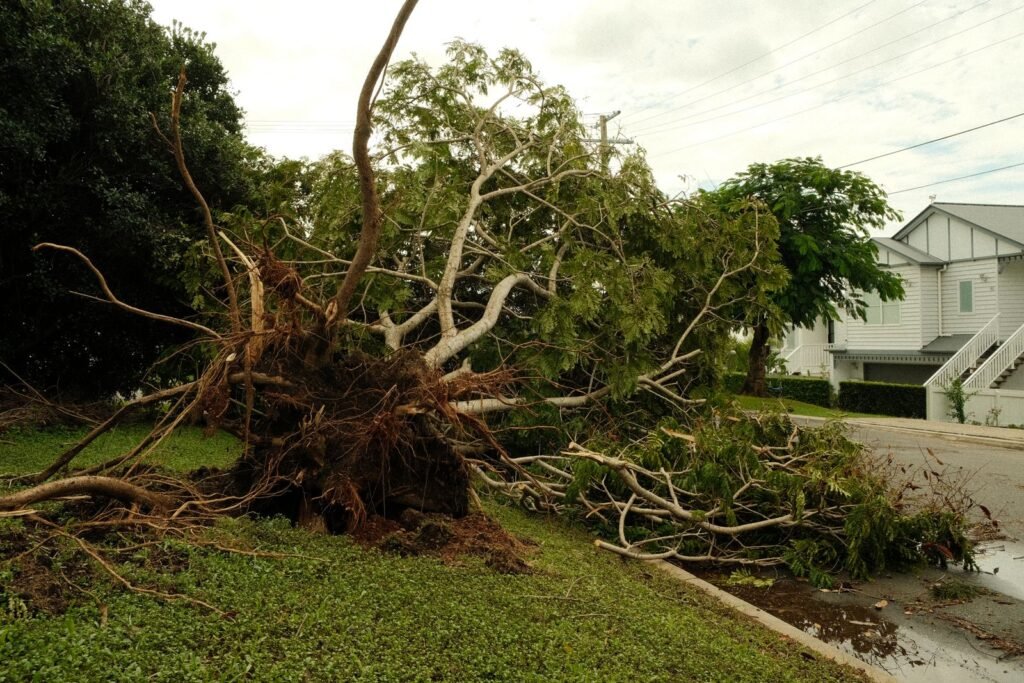
Fallen tree removal cost in Rochester NY depends less on how big the tree is and more on where it landed, what it landed on, and how urgently it has to come off. A big oak lying across open lawn can be a simpler job than a small maple resting on a garage corner, and homeowners are often surprised when the bill follows that logic.
After a lake effect storm or a summer thunderstorm, the first call is usually made in a hurry, with a tree down and a driveway blocked. This post explains how a downed tree is priced differently from a standing one, what ranges homeowners commonly see, and how insurance tends to fit in. Every number here is a general guide. Your actual price comes from someone looking at your tree in person.
Why a Fallen Tree Is Priced Differently
When a crew takes down a standing tree, they choose the direction and sequence. That control is what keeps the job predictable. A fallen tree takes it away. The wood is already lying wherever the wind put it, often under tension, with limbs pinned under the trunk and weight resting on whatever it hit.
That means cutting at awkward angles, supporting sections as they come free, and sometimes working around objects nobody planned for. It often needs more people and more equipment than the same tree would if it had been taken down on purpose. A fallen tree also tends to be an emergency, so the schedule is faster and less flexible, which affects the price.
Typical Fallen Tree Removal Cost in Rochester NY
Here are broad ranges homeowners in this region often run into. Treat them as rough orientation only. Prices vary by company, season, and the specifics of the job, and some jobs fall well outside these bands.
| What happened | General range |
|---|---|
| Small or medium tree down in open lawn | $300 to $900 |
| Large tree down, clear access, no damage | $800 to $2,000 |
| Tree across a driveway or fence | $600 to $2,500 |
| Tree resting on a roof, garage, or vehicle | $1,500 to $5,000 or more |
| Several trees after a major storm | Quoted as one larger job |
None of those figures are our pricing, and they shouldn’t be treated as quotes. A free on site estimate is the only way to know what your job will cost.
Is the Tree Resting on a House or Vehicle?
This is usually the largest factor in the final number. A tree that fell clear of everything is a contained cleanup. A tree leaning on a roof, a deck, or a car changes the whole job, because the crew has to take weight off the structure without letting a section shift, roll, or drop.
That usually means cutting the tree into smaller pieces than normal, holding each one with rigging as it’s cut, and moving slowly. Time and care cost money, and they also protect the damaged structure from getting worse. If a roof has taken a hit, it’s worth also asking a roofer to look once the weight is off.
Is It Blocking Your Driveway or the Road?
A tree across the only way in or out of your property raises the urgency even if the tree itself is simple. Same day or after hours work is typically priced differently than a routine appointment, and an urgent call can mean a crew rearranges its day to reach you.
Trees on a public road may involve the municipality or the utility, particularly if wires are tangled in the branches. Coordinating with them can add time and sometimes cost. Never approach a tree touching a power line. Treat the line as live and keep everyone back.
Rigging, Cranes, and Hung Up Trees
Some fallen trees can be handled with saws and a chipper. Others, especially big trees wedged against a house or caught in a neighbor’s tree, need rigging to control each section as it’s freed. A tree hung up in another tree looks stable and often isn’t, because the pressure in the wood can release suddenly. Those get extra caution and extra time.
Our crew uses climbing and rigging gear, spider lifts for tight backyards, and bobcat loaders to move heavy logs. A crane isn’t needed for every job, but if one is, it adds a real line item. That’s a good reason to ask any company what equipment they plan to bring.
Debris Is More Than the Trunk
A fallen tree seldom comes down tidily. Snapped limbs scatter across the yard, splintered wood litters the ground, and fences, shrubs, and smaller trees can be crushed underneath. All of that has to be gathered and cut to haulable size.
Storms rarely drop just one tree, which is why storm damage tree removal after a big event in Monroe County is often quoted as one job rather than separate tree prices. If your property took several hits, mention everything on the first call so it can be handled in one visit. Our emergency storm cleanup tips explain what to photograph and what to leave alone.
How Homeowners Insurance Usually Fits In
When Coverage Often Applies
Many standard homeowners policies help with tree removal when a tree has damaged an insured structure such as a house, garage, or fence, or when it blocks access to the home. Details vary by insurer and policy, so don’t assume either way. The Insurance Information Institute offers general background on how homeowners coverage works.
What Often Falls to the Homeowner
A tree that fell in the yard without touching anything is often treated as ordinary cleanup, which many policies don’t cover or cover only up to a limit. It’s one of the more frustrating gaps: the dramatic tree across the lawn can be cheaper to remove than the smaller one that clipped a roof, yet the roof tree is the one more likely to get insurance help.
Call your insurer before the work starts, take photos of the tree and the damage, and keep an itemized invoice. Our post on what to do after a tree falls on your property lists the steps in order.
What Decides Your Out of Pocket Number
Put together, fallen tree removal cost in Rochester NY comes down to three things: how much insurance covers if a structure was damaged, how complex the removal is based on position and equipment, and how much debris has to be cleared. Two trees of the same size can land far apart once those are counted. That’s why a phone estimate for fallen tree work is less reliable than an in person look.
If the tree isn’t down yet but looks unsound, acting now is almost always cheaper than waiting. Our tree removal cost guide covers standing trees, and the tree removal page explains how our process works. Homeowners in Greece and Webster deal with lake driven storms often, so response and equipment matter there as much as the base price. For wider outage and storm information, the National Weather Service winter safety page is a useful reference.
Frequently Asked Questions
Is a fallen tree more expensive to remove than a standing one?
Often, yes. The wood is under tension, the position is awkward, and the job is usually urgent. A tree down in open lawn can be simple, but one resting on a structure typically takes more time, more people, and more equipment.
Will insurance pay to remove a tree that fell in my yard?
It depends on the policy. Coverage is more likely when the tree damaged an insured structure or blocks access to the house. A tree that simply landed on the lawn may be treated as routine cleanup. Call your insurer before work begins.
Should I move a fallen tree off my car or roof myself?
No. The wood can shift or snap, and any contact with a power line makes it dangerous. Keep people away, take photos from a safe distance, and call a crew that has rigging gear and experience with loaded trees.
How quickly can a fallen tree be removed after a storm?
It depends on how many calls are coming in and how bad conditions are. Our emergency line is open 24/7. Tell us what’s blocked and whether wires are involved when you call.
Do I need photos before the tree is removed?
Yes, it helps. Photograph the tree where it landed, the damage to your property, and any wires or obstacles. Take wide shots and close ups, and keep your invoice, because your insurer may ask for both.
If a tree is down on your property, call (585) 888-9232 or request a free estimate. We’ll give you a clear picture of fallen tree removal cost in Rochester NY for your specific situation before any work begins.