
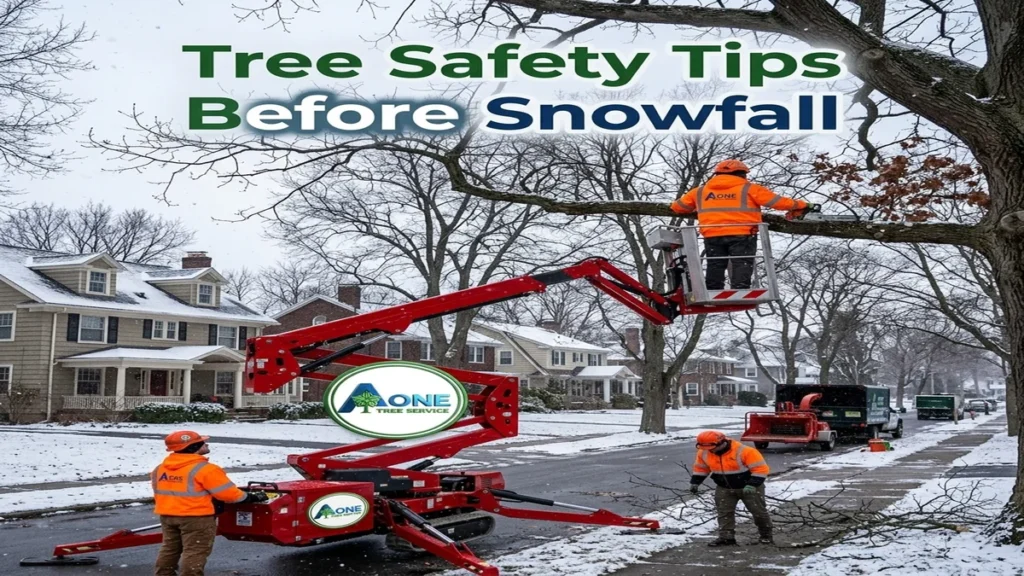
The forecast says six to twelve inches, maybe more if a lake-effect band sets up over your neighborhood, and it’s arriving tonight. This isn’t about general winter tree care — it’s about what to actually check and do in the hours before a heavy snowfall event hits, when there’s no time left for a full pruning job but plenty of time to catch the problems that turn into 2 a.m. emergencies.
Walk Your Property With a Specific Eye
Give yourself fifteen minutes before the snow starts to look at your trees the way a crew would — not for general health, but for anything that heavy, wet accumulation could turn into a failure point tonight.
What to Look For Right Now
- Branches already resting on or near the roofline, gutters, or power service line — snow load will push them lower, and contact that’s marginal today can become real damage overnight.
- Any limb with a visible crack, split, or hanging bark from a previous wind event that never got addressed — these fail first under added weight.
- Narrow branch unions with a tight V-shape rather than a wide U-shape, especially on maples and pears, which are prone to splitting under heavy snow load.
- Trees still holding significant leaf cover in an early-season snow — leaves catch far more snow than bare branches and dramatically increase the load a limb has to support.
Move What’s Underneath Before the Snow Piles Up
Anything parked or stored under a tree canopy with weak or overextended limbs is at risk the moment snow starts accumulating on those branches. Move vehicles away from trees with any known weak points, and don’t leave patio furniture, grills, or play structures directly under branches you’re already unsure about.
Don’t Try to Knock Snow Off Branches Yourself
Hitting or shaking a snow-loaded branch to clear it can snap it instead of relieving the weight, especially once ice has bonded the snow to the bark. It also puts you directly underneath a limb that may already be close to failing. Leave heavily loaded branches alone and let them shed naturally, or call a professional if one is threatening a structure.
During the Snowfall
Once the snow is actively falling, your job shifts from prevention to monitoring. Heavy, wet snow — the kind most common in Rochester’s late fall and early spring storms, as opposed to the lighter powder typical of a deep-winter lake-effect band — adds weight fast, and a tree that looked fine at the start of the storm can be under real stress two hours in.
- Keep an eye on any branch you flagged during your walk-through, from a safe distance and preferably through a window.
- Listen for cracking sounds, which often precede a limb failure by only seconds — if you hear it, move away from the area immediately.
- Avoid parking on the street directly under overhanging limbs, even ones that looked fine before the storm started.
After the Snow Stops
Assess before you assume everything held. Look for new leans, snapped tops, or limbs now resting on the roof or lines that weren’t a problem before. If a branch is hanging by a thread of bark or resting on a power line, don’t try to clear it yourself.
The Real Fix Happens Before the Next Storm
A pre-storm walk-through catches the obvious risks, but it can’t fix a structurally weak branch union or a tree that’s been overextended for years — that requires actual pruning done at the right time of year, which we cover in our guide to the best time to trim trees. If tonight’s storm made you nervous about a specific tree, it’s worth having it looked at properly once the snow clears rather than hoping the next storm goes better.
Frequently Asked Questions
How much snow does it actually take to damage a healthy tree?
A healthy, well-structured tree can typically handle a foot or more of snow without major issue. The real risk comes from wet, heavy snow combined with an existing weak point — a crack, a tight branch union, or leaves that haven’t dropped yet.
Should I prune my trees the same day a snowstorm is forecast?
No. Emergency pruning right before a storm is rarely effective and can be dangerous on ladders in worsening conditions. Address structural issues in advance, and treat the pre-storm walk-through as a check, not a fix.
Is it safe to shovel or clear snow near a tree during a storm?
Avoid lingering under any tree with loaded branches, even for routine tasks like shoveling. Clear paths away from the drip line where possible, and treat cracking sounds overhead as your signal to move.
What’s different about heavy snow risk versus ice storm risk?
Snow load builds gradually and tends to affect broad sections of canopy evenly, while ice coats every surface and adds weight even to small twigs, often causing more widespread breakage at lower wind speeds. Both call for the same pre-event walk-through, but ice tends to be less forgiving.