By the time a driveway is visibly cracked or a basement wall shows a hairline fracture, the root causing it has usually been growing under the slab for five to ten years. Understanding how roots actually cause this damage, not just that they do, is what makes the difference between a fix that lasts and one that fails again in a few seasons. Here’s what’s mechanically happening underground, and how to plan tree placement so it doesn’t happen again.
Root Heave: The Direct Mechanical Cause
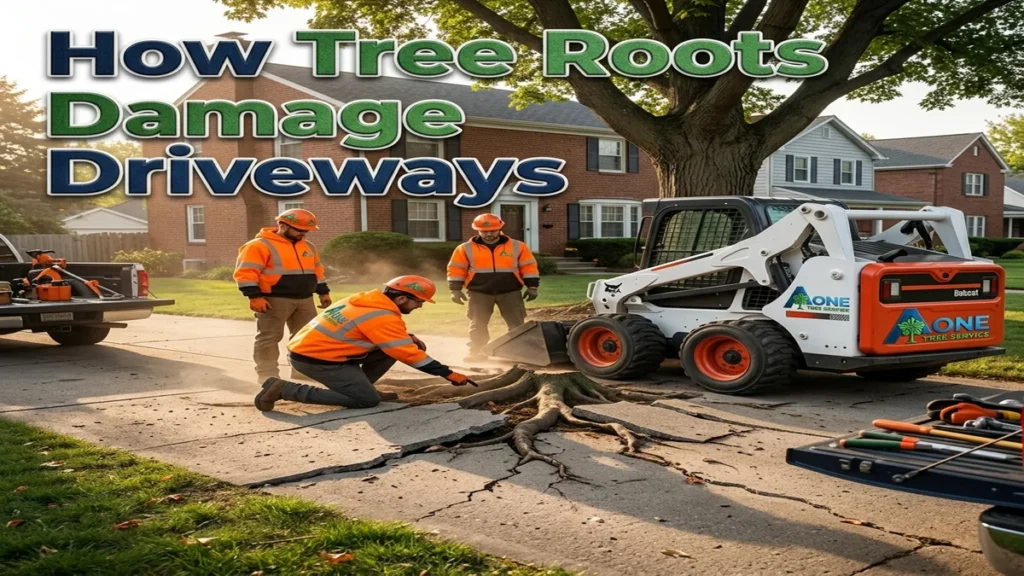
Most driveway and sidewalk damage isn’t from roots “growing through” concrete — it’s from roots growing thick enough, close enough to the surface, to physically lift the slab from underneath.
- Trees with shallow, spreading root systems, such as silver maple, willow, and cottonwood, are the most common offenders in Rochester yards, and they develop large surface roots that thicken over years, leaving a slab sitting directly above one nowhere to go but up.
- Compacted soil under pavement pushes roots to seek the path of least resistance, which is often laterally along the underside of the slab rather than straight down, concentrating pressure right where it does the most damage.
- Once a slab is cracked, the crack itself becomes an entry point for more root growth and water infiltration, which accelerates further heaving and cracking in a feedback loop.
Why Roots Grow Toward Foundations and Pipes in the First Place
Roots don’t deliberately target a house — they’re following moisture and oxygen, and foundations create conditions that happen to concentrate both.
The mechanisms at work:
- Moisture gradient: the soil around a foundation, especially near downspouts, sump pump discharge, or irrigation lines, tends to stay more consistently moist than open lawn, and roots grow preferentially toward that moisture.
- Sewer and water line leaks: even a small, slow leak in a clay or older PVC line creates a moisture and nutrient source that roots will grow directly toward and eventually infiltrate through joints and small cracks.
- Foundation drainage: french drains and footing drains create a loose, well-aerated gravel bed that’s easier for roots to grow through than dense surrounding clay soil, so roots follow the drain line itself.
Freeze-Thaw Cracking Makes Existing Damage Worse
Rochester’s winters add a second mechanism on top of root heave. Water that’s worked into a crack, whether the crack started from a root or from ordinary settling, expands roughly 9% when it freezes. Over a winter with repeated freeze-thaw cycles, that expansion widens the crack a little more each time, and by spring a hairline crack from October can be a half-inch gap. Root-heaved sections are especially vulnerable because the heaving itself has already created gaps and uneven support for water to collect in.
Why Cutting the Root Rarely Fixes It Alone
Cutting a problem root without addressing the tree often triggers a stress response that pushes even more root growth toward the same damaged area, and removing too much root mass on one side can destabilize the tree itself. In most cases, a proper fix means evaluating the whole tree, not just severing the visible root.
Prevention: Species Selection and Planting Distance
The most effective fix is avoiding the problem at planting time, which matters most if you’re landscaping a new build or replacing a tree that already caused damage.
General spacing guidelines:
- Large shade trees with aggressive, shallow root systems, including silver maple, willow, cottonwood, and Norway maple, should generally be planted at least 20 to 30 feet from foundations, driveways, and underground utility lines.
- Smaller ornamental and deep-rooted species, such as dogwood, serviceberry, and many oaks, can typically be planted closer, often within 10 to 15 feet, with lower long-term risk to hardscaping.
- Any tree planted near a driveway or walkway benefits from a root barrier installed at planting time, which directs root growth downward and outward instead of laterally toward the slab.
- Existing mature trees already close to a foundation are usually better managed with monitoring and selective root pruning than by planting new problem trees nearby in the future.
When Removal Is the Right Call
If a tree is already causing active foundation or driveway damage and it’s a species known for aggressive root systems, removal is often more cost-effective long-term than repeated concrete repairs. Tree removal paired with stump grinding eliminates the root source entirely rather than leaving a stump that can continue sending up root suckers for years. If you’re not sure whether a specific tree’s roots are the actual cause of damage you’re seeing, our guide on 8 signs a tree needs removal covers the visible symptoms worth checking for before deciding.
Frequently Asked Questions
How close is too close for a tree to be planted to a house?
It depends heavily on the species. Large, shallow-rooted trees should generally be 20 to 30 feet from a foundation, while smaller or deep-rooted species can often be planted within 10 to 15 feet without significant long-term risk.
Will cutting a root that’s damaging my driveway kill the tree?
It depends on how much root mass is removed and where. Cutting a small percentage of a tree’s total root system is usually survivable, but cutting large roots close to the trunk, or cutting extensively on one side, can destabilize or seriously stress the tree.
Can tree roots actually get inside a sewer line?
Yes. Roots are drawn to the moisture and nutrients in even a small leak at a pipe joint, and once a fine root gets inside, it thickens over time and can eventually block or crack the pipe from within.
Does removing the tree stop the driveway damage from getting worse?
Removing the tree stops new root growth, but existing roots under the slab will decay slowly over years rather than disappearing immediately, so some settling can still occur temporarily as they break down. Full stump and root grinding speeds this up considerably.