
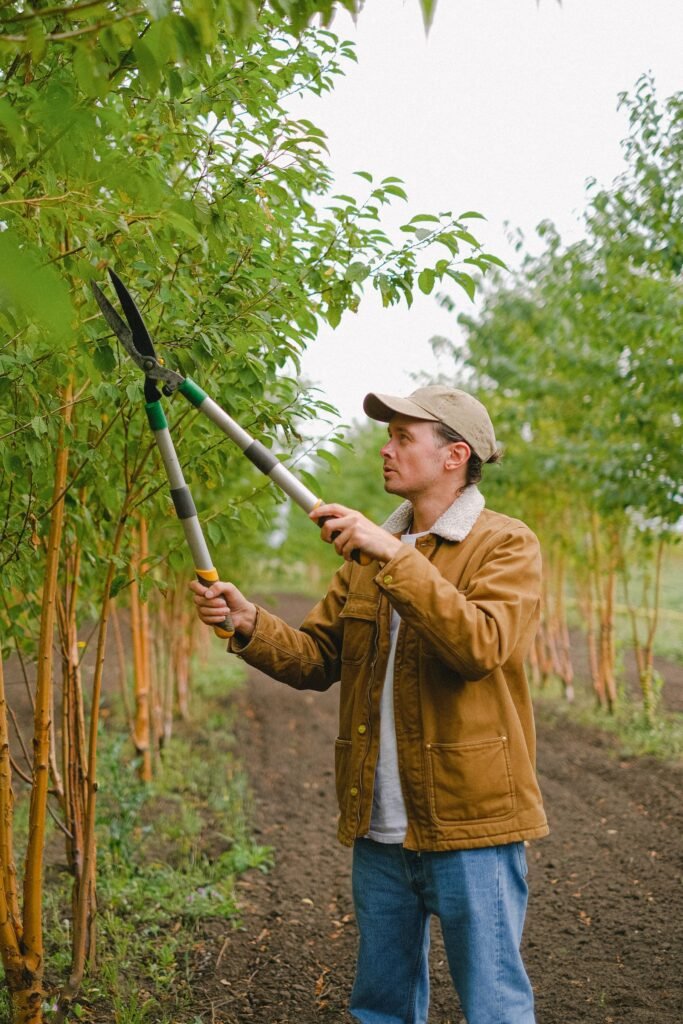
How often should you trim trees in Rochester NY? Ask five homeowners and you will get five confident answers, from “every year without fail” to “never, it’s a tree.” Both camps are wrong. The right interval depends on the tree’s age, its species, how close it stands to your house, and how much weather it has absorbed lately, and A One Tree Services walks yards every week where a single lot needs two or three different schedules.
This post is about frequency, meaning how many years to leave between visits. If you are wondering which season to book, that is a separate question we cover in our post on the best time to trim trees. Here is how to work out a rhythm that fits the trees you actually own.
How Often Should You Trim Trees in Rochester NY? Start With Age
A tree’s age is the first dial to turn. In its first five to ten years a tree is building the skeleton it will carry for the next half century, and small cuts made at that stage have an outsized effect. A strong central leader, branches spaced so they do not rub, and weak V shaped forks removed early all pay off decades later.
For a young tree, plan a light check every one to two years. These are small, corrective cuts, not heavy hauling. Skipping them rarely saves money. A problem fixed with a pruning shear at year three often needs a crew, a lift, and a lot more wood on the ground by year fifteen. We see this constantly with fast growing silver maples planted as a quick shade fix, then left alone while the trunk splits into two competing stems.
Mature Shade Trees Can Stretch the Interval
Once a tree settles into a stable structure, usually somewhere past its first decade or two depending on species, growth slows and so does the need for work. A healthy mature oak or sugar maple in open lawn, well away from the house, can often go three to five years between visits. Those visits focus on deadwood, crossing limbs, and keeping the canopy balanced, not reshaping.
Longer interval does not mean no attention. Big old trees carry the most weight, so a failing limb does the most damage. Even on a long cycle, have someone look up into the crown now and then. Our post on the benefits of professional tree trimming explains what a trained eye spots that a homeowner standing on the lawn cannot, such as a crack hiding behind foliage.
Fruit Trees Follow Their Own Calendar
Apple, pear, and cherry trees are the exception to every rule above. They do best with yearly pruning, because thinning the canopy lets light and air reach the fruiting wood, and it keeps the tree from tangling itself into a mess that gives smaller fruit and invites disease. That work is usually done while the tree is dormant.
Do Not Prune the Whole Yard Like the Apple Tree
Homeowners who learn that their apple tree wants yearly attention sometimes decide every tree does, then over prune a mature maple that would have been happier left alone. Fruit trees are pruned for harvest and structure. Shade trees are pruned for structure and safety. Treat them as two schedules, not one.
Location Can Shorten the Schedule
Where a tree stands matters as much as how old it is. A tree within falling distance of your house, garage, or driveway deserves a look every one to two years, because the cost of a missed problem is so much higher. Pay attention to branches creeping toward the roofline, limbs hanging over a bedroom, and any new dead section that was not there last year.
Trees growing into or beside overhead utility lines are a separate category. Never prune near a line yourself, and do not assume the tree will wait politely for your next scheduled visit. If a tree near your home also carries significant decay or storm damage, the honest answer may be that trimming is no longer enough and tree removal is the safer call.
Species and Growth Rate Matter More Than You Think
A willow, poplar, or silver maple can push several feet of growth in a season and builds weak wood to do it. Those trees tend to need a tighter interval than a slow oak or hickory of the same age. Callery pear is another one to watch. It grows fast, forms tight branch unions, and is notorious for splitting in storms, so a periodic structural check is cheap insurance. Know what you have before you pick a schedule, and if you cannot name the tree, a quick walk with a professional will tell you in a minute.
| Tree situation | Typical check interval |
|---|---|
| Young tree, first 5 to 10 years | Every 1 to 2 years, light structural cuts |
| Mature shade tree in open lawn | Every 3 to 5 years |
| Fruit tree | Every year, while dormant |
| Near a roof, driveway, or power line | Every 1 to 2 years at any age |
| Fast growers like silver maple or willow | Shorter end of whichever range applies |
What Lake Effect Weather Adds to the Equation
Trees in Monroe County put up with ice loaded branches, heavy lake effect snow, and fierce spring and summer thunderstorms. All of that is mechanical stress, repeated year after year. A tree that could go five calm years between visits somewhere gentler may be better off with a look closer to every three here.
Treat the table as a starting point, then adjust for what actually happened. A quiet year might mean nothing needs doing. A winter with a major ice event, or a summer microburst, is a reason to inspect off schedule, particularly if you saw limbs sag or crack. Our guide on how winter weather damages trees shows what hidden damage looks like. If you want more background on pruning practice, the International Society of Arboriculture consumer site publishes plain language guidance on pruning young and mature trees.
Signs Your Trees Are Asking for Attention Early
A calendar is a good habit, but trees do not read calendars. Some signals mean skip the schedule and act. Watch for a limb that droops lower than it did last year, bark that has peeled away from a branch collar, a cluster of dead twigs at the outer edge of the canopy, or mushrooms growing near the base. Any of those can point to decay or stress that will not wait until the next planned visit.
Local growing conditions play a part, too. Heavy clay soil holds water in spring and bakes in August, and a tree that struggles through both extremes can drop deadwood faster than its age suggests. Your county extension office, Cornell Cooperative Extension Monroe County, is a good local resource for questions about soil, pests, and species that suit this area.
Building a Schedule You Will Actually Follow
The simplest method is a walk once a year. Late fall after the leaves drop, or early spring before they open, gives the clearest view of the branch structure. Write down which trees look fine, which are close to something valuable, and which have anything dead, rubbing, or hanging low. Young trees and anything near a structure go on the short list.
If that self check leaves you unsure, a professional walkthrough removes the guesswork. Our tree trimming crew will look over the whole property and tell you honestly which trees need work now and which can wait, instead of cutting everything on one cycle out of caution. Over a decade, a tailored schedule costs less than either extreme, whether that is trimming every tree every year or letting problems build until a storm forces the issue.
Mixed age yards are especially common in Fairport and Perinton, where young landscaping trees share lots with big older shade trees. One yard, two schedules, running side by side. When you want a second opinion on the whole property, we offer a free estimate, and you can also call (585) 888-9232 any hour of the day.
Frequently Asked Questions
How often should you trim trees in Rochester NY if you do not want to think about each tree?
A reasonable default for healthy, established trees away from structures is a check about every three years. Young trees and anything near your home or power lines get checked more often, roughly every one to two years. Treat that as a starting point to adjust, not a fixed law.
Can trimming too often hurt a tree?
Yes. Removing too much live growth too often stresses a tree, can trigger a flush of weak regrowth, and leaves less energy for roots and disease resistance. More frequent is not automatically better. The right schedule matches what the tree needs.
How do I know a tree needs work now instead of waiting for its normal cycle?
Dead or broken branches, storm damage, limbs rubbing a roof or siding, and any sudden new lean are all reasons to move a visit up. Cosmetic shape concerns can wait for the regular schedule.
Do evergreens need trimming as often as maples and oaks?
Usually less often, since spruce and white pine have a naturally strong central form. They still benefit from periodic deadwood removal, and young evergreens being shaped near a property line may need a bit more attention.
Should one bad storm change my whole schedule?
One storm does not necessarily rewrite your long term plan, but it is worth an inspection afterward for hidden damage such as cracked branch unions that are hard to see from the ground. If a tree takes repeated storm stress over several seasons, a shorter interval going forward makes sense.
So, how often should you trim trees in Rochester NY? Less often than a nervous homeowner fears, more often than a neglected yard gets, and always with the age, species, and location of each tree in mind. A steady schedule keeps small jobs small and emergency calls rare. Book your free, no obligation estimate and we will tell you what can wait.