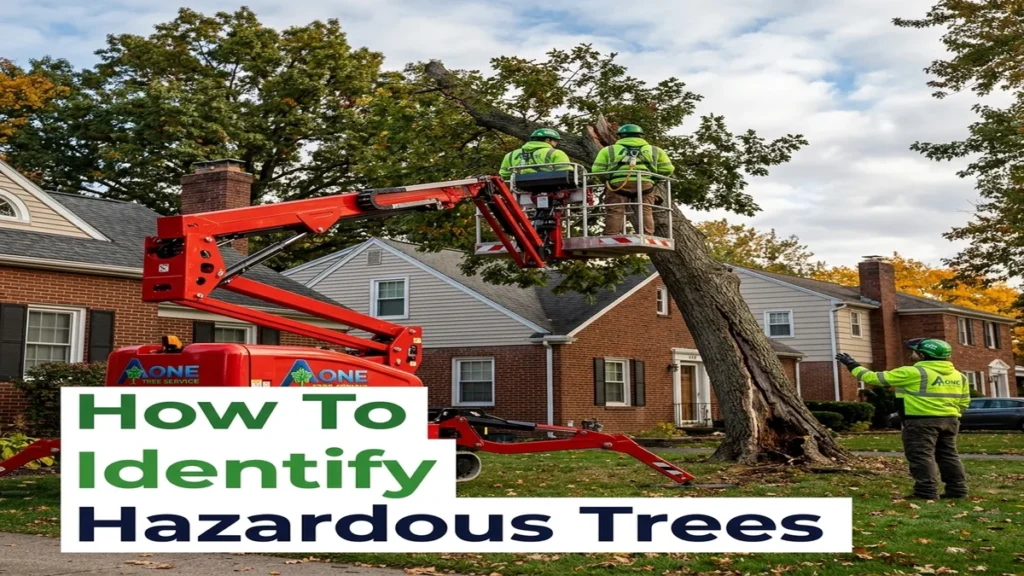
Learning to identify a hazardous tree is a skill worth having, because the trees that hurt people and property are rarely the ones with a big flashing warning sign. Most look fine from the porch right up to the storm that takes them down.
You do not need a degree to spot the common warning signs. You need to know where to look and how to read what you see: the base, the trunk, the crown, the soil, and what sits underneath. This guide walks through each one, explains how to judge risk, and tells you when it is time to stop looking and call a tree crew.
What Makes a Tree Hazardous
A hazardous tree is not just a sick tree. It is a tree with a defect, plus a target. The defect might be rot, a crack, a lean, or dead wood. The target is anything that would be hurt if the tree or part of it failed: the house, the driveway, a play area, a parked car, a power line, or the street.
That is why one dead tree at the back of a big lot may be a low priority, while a similar tree leaning over a bedroom is urgent. When you identify a hazardous tree, you are really asking two questions: how likely is it to fail, and what will it hit?
How to Identify a Hazardous Tree From the Ground Up
Start at the bottom and work up. Most structural problems begin at the roots and the base.
Check the base and roots
Look for mushrooms or conks growing from the trunk or roots, which often point to decay inside. Notice soil that has heaved up on one side, cracks in the lawn around the trunk, or roots that have been cut by trenching or construction. A trunk that looks swollen or hollow at the bottom deserves attention. Our post on signs of tree root damage around your home goes deeper on what the ground is telling you.
Read the trunk
Vertical cracks, bark that is peeling away in sheets, cavities, oozing sap, and woodpecker holes all matter. A single crack is not always a death sentence, but a long crack that runs through a fork or down the trunk usually is a serious sign. Look for included bark in a fork, where two stems of similar size grow together with bark squeezed between them. That union is weak, and it is common in silver maple and Callery pear.
Look at the crown
Dead branches, thin foliage, leaves that come in late or drop early, and large broken limbs hanging in the canopy are all signs of trouble. Dead wood in the crown can drop in a breeze. Dieback that begins at the top of an ash is a classic sign of emerald ash borer, and the emerald ash borer information site has photos of what to look for.
Check the lean
Some trees lean naturally and have grown that way for decades. A new lean, or a lean that is getting worse, is different. If the soil on the opposite side is lifting, the roots may be failing. That is an emergency, not a project.
Warning Signs by Local Species
Some trees have a record around here. Knowing the weak spots of the species in your yard helps.
- Ash. Thin crown, bark flaking off in patches, and small D shaped exit holes can all point to emerald ash borer. Dead ash becomes brittle quickly and is dangerous to climb.
- Silver maple. Hollow trunks and large splitting limbs. It is fast growing and often brittle.
- Callery pear. Tight forks that split in snow and wind.
- White pine and spruce. Shallow roots can lose their grip in saturated soil, and the weight of a full crown makes them top heavy.
- Oak. Strong, but hollow cavities, mushrooms at the base, and sudden leaf browning in summer are worth a look.
- Willow and poplar. Soft wood that breaks easily, with an appetite for water that can push roots into pipes.
We cover more about regional diseases in common tree diseases in Monroe County.
Weather Makes Weak Trees Worse
Lake effect snow, ice, and strong wind do not create most tree problems, they expose them. A tree with a cracked fork that has been fine for years may split in the first heavy storm of the season. Saturated soil after spring rain loosens roots. Ice coats the crown and adds a lot of load.
Our post on what causes trees to fall during storms breaks down how wind, saturation, and structural weakness combine. If you spot a defect before the season, you can often fix it by removing the bad limb or taking the tree down on a calm, dry day, instead of cleaning up after a storm.
Judging the Risk: A Simple Way to Think About It
Once you have found a defect, rank the risk with a few plain questions.
- How serious is the defect? Dead, cracked, or leaning is worse than a small cavity.
- How big is the part that could fail? A twig is not a concern. A limb the size of your leg is.
- What is underneath? A house, a driveway, a swing set, or a parking spot raises the stakes.
- How often is the area used? A busy spot near the kitchen door matters more than a far corner of the yard.
- What is the weather outlook? A weak tree before a big storm is a rush job.
Reputable tree care companies use risk assessment standards of this kind, and the Trees Are Good consumer site from the International Society of Arboriculture gives homeowners a plain language overview. For a more detailed checklist of removal signs, see 8 signs a tree needs immediate removal.
Changes Around the Tree That Raise the Risk
Sometimes the tree has not changed, but its surroundings have. A new driveway, a trench for a utility line, a regrade that piled soil against the trunk, or an addition that took away a neighboring windbreak can all stress a tree that was stable for decades. Roots that were cut during digging may not show a problem for a few seasons, then the tree starts to lean or thin out.
Lawn care matters too. Mower and string trimmer damage at the base opens the bark to decay, and mulch piled against the trunk holds moisture where it should not. If you are planning any digging near a large tree, call 811 first through Dig Safely New York and keep heavy equipment off the root zone.
What to Do Once You Find One
Keep people and cars away from the danger zone. Photograph what you see. Do not try to fix it by climbing or cutting, because a compromised tree can fail while someone is in it, and ladders and chain saws do not mix with overhead hazards.
Call a crew for an on site assessment. We offer free estimates, and the plan might be a pruning job, removal of a dead limb, cabling, or a full tree removal. If the tree is already failing, our emergency tree removal service runs 24/7. Our post on why dead trees are dangerous explains why waiting is rarely a good bet.
A seasonal habit helps. Walk your yard in spring and fall with the checklist above, and consider a professional once over every year or two on mature trees. The idea is covered in the benefits of seasonal tree inspections.
Frequently Asked Questions
How can I tell if a tree is dangerous?
Look for dead branches, cracks, cavities, mushrooms at the base, soil lifting, and a new or worsening lean. Then ask what the tree could hit. A defect near a house or a power line is higher priority.
Is a tree with a hollow trunk always unsafe?
Not always. Some hollow trees stay stable for years, but the amount of sound wood left matters. A crew can assess how much strength remains and whether the tree is near a target that makes it a concern.
Can I identify a hazardous tree myself?
You can spot many warning signs, such as dead limbs, cracks, and leaning. Deciding how serious they are usually takes an experienced eye, so call a professional if the tree is large or sits near your house.
What if a tree is leaning after a storm?
Treat a new lean as urgent, especially if soil is lifting or cracking at the base. Keep people away from the area and call a tree crew to assess it.
Do dead trees need to come down right away?
Dead trees become brittle and unpredictable. Urgency depends on the size and what is below, but dead trees near homes or paths should not wait for the next storm.
How do I schedule a hazard assessment in Rochester?
Call (585) 888-9232 or use our contact page. A crew will look at the tree on site, explain what they see, and give you a free estimate for any work you decide to do.
Knowing how to identify a hazardous tree gives you a head start, but you do not have to make the final call alone. Call (585) 888-9232 or request a free estimate, and we will walk your yard, tell you which trees are fine, and help you deal with the ones that are not.