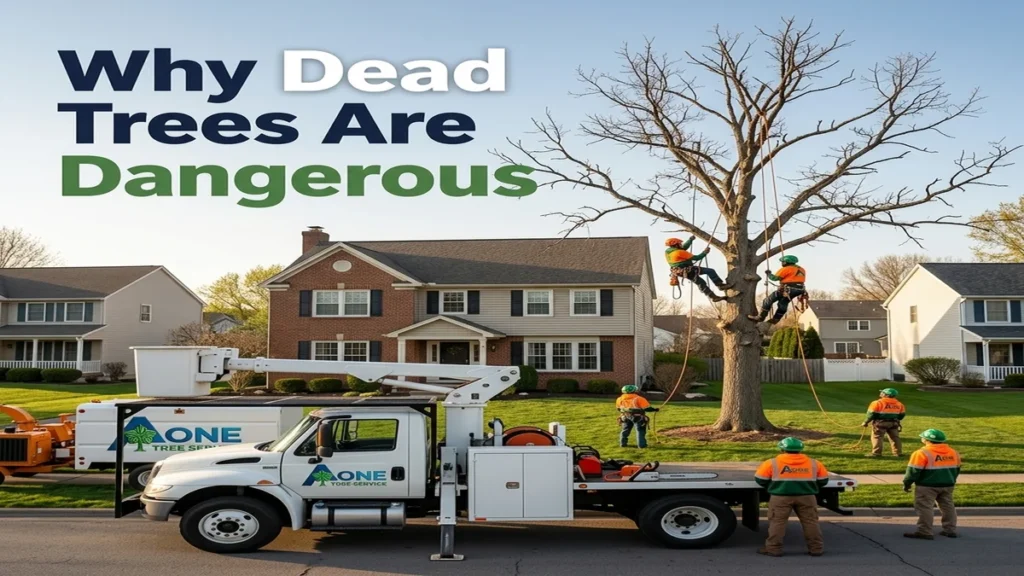
Why dead trees are dangerous comes down to one fact: wood that is no longer alive stops repairing itself, and it only gets weaker from here. A dead tree standing in a Rochester yard can look solid for another year or two, then drop a limb on a calm afternoon or fall whole in the first strong lake wind. A One Tree Services removes dead and dying trees across Monroe County, and in almost every case the homeowner says the same thing: it looked fine until recently. This post explains what is happening inside that tree, how to tell, and what to do about it.
Why Dead Trees Are Dangerous Compared to Living Ones
A living tree is constantly managing itself. It seals wounds, adds a new layer of wood every year, and bends under wind because its fibers are flexible and full of moisture. A dead tree loses all of that. Fungi and insects move in, the wood dries out and turns brittle, and strength drains away from the inside out while the outside stays deceptively intact.
The result is a tree that fails in ways living trees do not. A live limb tends to bend and sag before it breaks. A dead limb can snap clean with no warning, because brittle wood does not give. That is why arborists treat a dead tree near a house, driveway, or play area as a hazard, not as a maybe.
The International Society of Arboriculture’s consumer tree care site lists dead and dying wood among the first things to look for when judging risk, and our own experience on Rochester properties backs that up.
The Hazards a Dead Tree Actually Creates
People tend to picture a tree toppling onto a roof. That does happen, but it is only one of several problems.
- Falling limbs. Dead branches, sometimes called widowmakers, can drop from high in the canopy. They come down fast and hit hard, even when the rest of the tree is standing.
- Whole tree failure. Rotted roots or a hollow trunk can let the whole tree go in a storm, or even without one.
- Damage to structures and vehicles. A single large limb can punch through a roof, crush a car, or take down a fence.
- Utility line contact. A tree that falls into wires creates a danger that goes beyond the tree itself. Stay back and call for help.
- Spread of pests and decay. A dead tree can host insects and fungi that move to healthy trees nearby.
- Danger during removal. The longer a dead tree stands, the more brittle it gets, and the harder and riskier it is to take down safely.
That last point is the one people miss. Brittle wood does not behave the way a crew expects when it is cut, and a tree that has been dead for several years can shatter or shift as it is climbed or rigged. Waiting does not make the job easier. It makes it harder.
Warning Signs Your Tree May Already Be Dead
Dead does not always mean leafless. A tree can be dead in some parts and alive in others, or dead at the roots while the canopy leafs out one last time. Here is what to check:
- No leaves or buds on the whole tree, or a large section, during the growing season. Compare it to neighboring trees of the same species.
- Bark that is loose, peeling off in large pieces, or missing, leaving bare gray wood underneath.
- Brittle twigs that snap clean instead of bending. A scratch on a small twig that shows brown or dry tissue underneath instead of green is a bad sign.
- Mushrooms or shelf fungus at the base or on the trunk, which often point to rot.
- Woodpecker holes, sawdust, or tunnels in the bark, which can signal insects feeding on a declining tree.
- Deep cracks, a hollow sound when you tap the trunk, or large cavities.
The big regional threat to be aware of is emerald ash borer. Ash trees killed by this beetle can go from thin and struggling to dead fast, and the wood turns unreliable soon after. The emerald ash borer information network describes the signs, and our post on common tree diseases in Monroe County covers what else to watch for.
Why Dead Trees Are Dangerous Even When They Look Fine
A tree that is dead standing can hold its shape for a long time, especially a hardwood like oak, which makes it easy to talk yourself into waiting. The danger does not scale with how the tree looks. It scales with how much wood has decayed, and you cannot see inside a trunk.
In our area the stresses add up fast. Lake effect snow piles weight on branches. Ice storms coat them. Freeze thaw cycles crack bark and open wood to moisture. Summer thunderstorms bring gusts. A dead tree has to survive all of that with none of the flexibility of a living one, so each season it is closer to its limit.
Trees in older neighborhoods, such as Brighton, Pittsford, and Gates, are often big and tall. When one of those fails, it has far more mass behind it. Our page on tree service in Brighton NY describes the kind of mature trees we work around there.
Who Is Responsible When a Dead Tree Falls
If a dead tree on your property drops a limb or falls, the question of responsibility can get complicated quickly. A tree that was clearly dead and ignored is harder to defend than one that failed from a sudden storm. Insurance policies and local rules differ, so we cannot tell you how it will go on your claim. What we can say is that homeowner policies often treat neglected hazards differently from sudden storm damage, so documenting that you acted on a known problem helps.
The Insurance Information Institute has consumer guides on homeowners coverage, and your own agent can tell you how your policy handles fallen trees. If the dead tree belongs to a neighbor and leans onto your side, read our post on what happens when a tree falls on a neighbor’s yard.
What to Do If You Suspect a Dead Tree on Your Property
First, keep people and vehicles out from under it. Move the picnic table, the swing set, and the parked cars if you can. Do not climb it or cut it yourself. A dead tree is exactly the wrong place for a first time chainsaw job.
Next, get a close look from someone who can judge it. We evaluate the tree during a free estimate, checking the trunk, roots, and crown, and we will tell you plainly if it can be saved or needs to come down. If removal is the answer, our tree removal crews use spider lifts, rigging, bobcat loaders, and high capacity chippers to take the tree down in controlled sections, even in a tight backyard.
If the tree is already leaning, cracked, or resting on something, treat it as an emergency. Our emergency tree removal line is open 24 hours a day, 7 days a week. For related reading, see how to identify hazardous trees.
After removal, ask about stump grinding. A dead tree’s stump is often already rotting, and it is easier to deal with while the crew is on site.
Frequently Asked Questions
How can I tell if a tree is dead or just dormant?
In winter, check small twigs for green tissue under the bark and look for buds. In summer, a tree with no leaves while its neighbors are in full leaf is likely dead. A tree professional can confirm it quickly.
How long can a dead tree stand before it falls?
There is no safe timeline. Some stand for years and others fail in the first storm. Because decay happens inside, the only reliable move is to have the tree checked and not assume it will hold.
Can a dead tree be saved?
No. Once the whole tree is dead it cannot recover. A tree that is only partly dead or declining may be helped by pruning and care, which is why a proper evaluation is worth it.
Is it cheaper to remove a dead tree early?
Often, yes. Taking down a tree before it fails avoids damage to your house or fence, and a tree that is brittle is more difficult to take down later. Price depends on size and access, and we give a free on site estimate.
Should I remove a dead tree myself?
We advise against it. Dead wood is unpredictable, and falling limbs and kickback cause serious injuries. Leave it to a fully insured crew with the right gear.
What if the dead tree is near power lines?
Stay away and do not touch it. Contact the utility and a professional crew, because limbs near lines are dangerous even when they look small.
Now you know why dead trees are dangerous, and why waiting rarely helps. If there is one on your property, request a free estimate or call (585) 888-9232 any hour. We are open 24 hours, 7 days, and fully insured.