
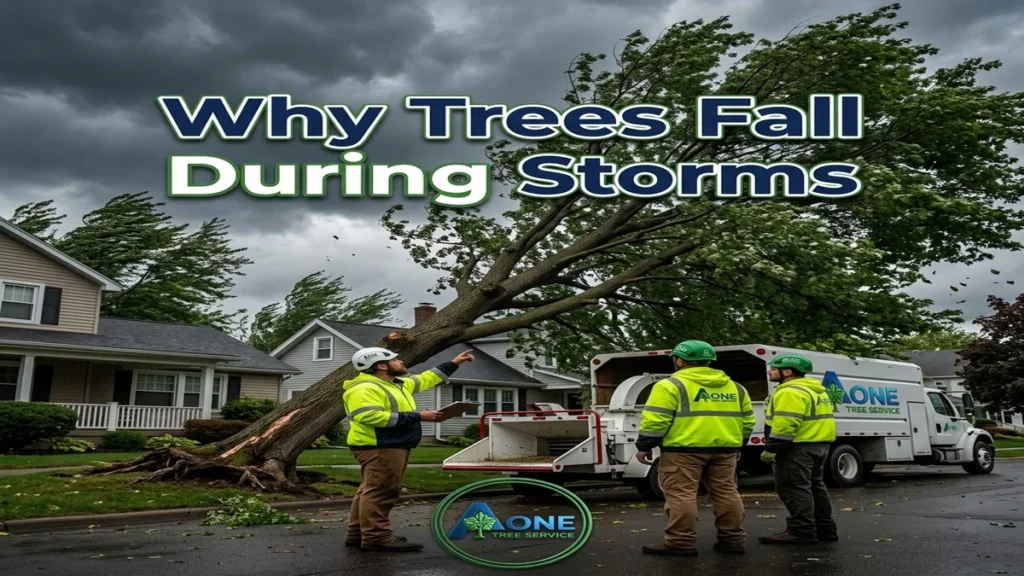
The causes trees to fall during storms are mostly predictable, and that is the good news. A tree that comes down in a Rochester thunderstorm or lake wind event rarely fails out of nowhere. Something was usually wrong for years: a root system chopped by a trench, a trunk quietly rotting from the inside, a canopy with one heavy side, or soil that stayed soaked for a week before the wind arrived. A One Tree Services clears fallen trees across Monroe County, and the pattern in the wreckage repeats so often that we can tell you what to look for before the next storm.
The Causes Trees to Fall During Storms Often Start Underground
When a whole tree tips over with a rootball lifting out of the lawn, the story almost always starts below ground. Tree roots are shallow, wide, and fussy. Most of the roots that hold a tree up sit in the top foot or two of soil and spread well beyond the drip line. Anything that cuts, crushes, or suffocates that zone weakens the tree’s anchor.
The usual culprits around Rochester homes are easy to spot once you know them:
- A trench dug for a utility line, drain, or new walkway that sliced through major roots a few years ago.
- Soil piled around the base after grading, which smothers roots and hides the trunk flare.
- A driveway, patio, or addition built close to a mature tree, leaving it a fraction of the root space it had.
- Heavy clay that stays wet, starving roots of oxygen so they grow shallow and weak.
A tree can look healthy for years after root damage. Then one strong gust finds the weak anchor. If you have seen roots damage hardscape, our post on how tree roots damage driveways and foundations shows what that stress looks like from the surface.
Saturated Soil Turns a Wind Event Into a Tree Failure
Rain does more than make a storm unpleasant. Heavy clay soil, which is common across much of the Rochester area, holds water and goes soft. A tree standing in saturated ground has far less grip on its roots. Add wind and the whole root plate can rock loose and heave up.
That is why trees sometimes come down a day or two after the rain, when the ground is still soft and a breezy afternoon follows. It also explains why a spring storm after snowmelt can do more damage than the same wind in a dry August. If your yard stays boggy and you have a big tree leaning even slightly, treat a wet week plus a forecast of strong wind as a warning sign.
Decay You Cannot See From the Lawn
Another one of the main causes trees to fall during storms is internal rot. A trunk with a hollow center can look fine from outside and still be a fraction as strong as it appears. Wind loads a tree at its weakest point, and decay creates exactly that weak point.
Walk around the base and the trunk and look for these signs:
- Mushrooms or shelf like fungus growing on the trunk or at the base.
- Cavities, old wounds that never closed, or bark that is peeling away in sheets.
- Deep vertical cracks or a seam that seems to be opening.
- Sawdust like material at the base, which can point to insects working inside.
Our guide to how to identify hazardous trees goes through these in more detail. And if a tree is already dead, the rules change completely, as we explain in why dead trees are dangerous.
Wind Load, Leaf Cover, and Canopy Shape
The wind does not push on a tree evenly. A full summer canopy acts like a sail, catching far more wind than the same tree does in January. That is why a thunderstorm in July can topple trees that would have survived the same gusts in winter. Lake Ontario adds its own pattern, with strong winds off the water that hit shoreline towns like Greece, Irondequoit, and Webster harder than neighborhoods farther inland.
Shape matters too. A tree with a lopsided crown, most of the weight reaching toward the house or street, has a long lever arm working against the trunk. A tall, dense crown on a thin trunk catches a lot of wind. Trees in a thick stand lose the support of their neighbors when one is removed, which is why a tree that stood fine for years can suddenly fail after a nearby tree is cleared. Wind passes through the gap and hits the survivor with force it never had to handle before.
Ice and Heavy Snow Overload Branches
Not every storm failure is the whole tree. Lake effect snow and ice storms load branches with weight they were never built to carry. A glaze of ice can multiply a limb’s weight several times, and when the weight exceeds what the wood or the branch union can take, the limb tears off. Often it takes bark and a strip of trunk with it.
Some trees are more prone to this. Silver maples have brittle wood and tend to shed limbs. Callery pears split at narrow V shaped crotches. Birch and poplar are short lived and often soft inside. White pines catch snow on long needles and can lose upper stems. You can read more about what winter does to trees on our post about how winter weather damages trees, and follow weather alerts from the National Weather Service Buffalo office, which covers Rochester.
Poor Structure From Past Damage or Neglect
The history of a tree shows up in a storm. Trees that were topped years ago grew back with weak, poorly attached shoots. Trees with included bark, where two trunks press together with bark trapped between them, tend to split down the middle. Trees pruned badly, left with stubs, or hit by a mower again and again carry long term wounds.
Prior storm damage matters as well. A tree that lost a big limb three years ago and never got cleaned up may have an open wound, decay spreading inward, and a crown that is out of balance. These are the trees a pruning visit can often fix or at least help before the next storm.
What You Can Do Before the Next Storm
Once you know the causes trees to fall during storms, the prevention list gets short. You cannot stop a storm, but you can lower the odds that a tree on your property comes down in one. Start with a slow walk around your yard each spring and fall. Look up for dead limbs and down for fungus, heaving soil, or new cracks. Check whether a tree has begun to lean compared with last year, especially if the soil on one side looks lifted.
Then act on what you find. Deadwood removal and structural pruning through our tree trimming service lowers the weight a tree has to hold up. A tree with a serious defect, like a split trunk or a large rotten cavity, may be better served by tree removal than by another year of worry. Our post on signs a tree needs removal helps you make that call.
Keep trees at a safe distance from your house and wires when you plant, and avoid regrading or trenching close to a mature trunk. If you must dig, call 811 first through Dig Safely New York, and ask a tree professional how to protect the roots.
If a Tree Has Already Come Down
Stay away from it, and especially from anything it touches. A tree resting on a line, a roof, or other trees can hold tension and shift without warning. Treat any downed wire as live. Once you are safe, photograph the damage for your insurance company and call us. We run a 24/7 emergency line for exactly this, and our storm damage tree removal crews can work with spider lifts where a standard truck cannot reach, then clear the debris with chippers and bobcat loaders.
Frequently Asked Questions
What is the number one reason trees fall in storms?
Root problems and hidden decay top the list. A tree can only stay upright if its roots hold the soil and its trunk is solid. When either is compromised, ordinary wind loads become enough to bring it down, especially in wet ground.
Are healthy trees safe in strong storms?
Healthy trees handle most storms, but no tree is storm proof. Extreme wind, ice, or saturated soil can overwhelm even sound trees, which is why good structure and regular pruning help lower the risk.
Can I tell if a tree is likely to fall?
Often, yes. Warning signs include a new lean, soil heaving at the base, mushrooms on the trunk, deep cracks, hollow areas, and large dead limbs. If you see any of these, have a tree professional look at it before the next storm.
Does trimming a tree make it less likely to fall?
Proper trimming can help. Removing dead limbs, reducing heavy side branches, and thinning a dense crown lowers the load on the trunk and lets wind pass through. Cutting too much, or topping, does the opposite and weakens the tree.
Why do trees fall after the storm has passed?
Soaked soil, damaged roots, or a partly cracked trunk can fail hours or days later. A tree that was stressed during the storm may also shift under later wind or the weight of the snow.
What should I do if a tree falls on my house?
Get everyone out of the area, stay away from any wires, and call emergency services if anyone is hurt or there is a hazard. Then call us at (585) 888-9232 for emergency removal, and photograph the damage for your insurance claim.
The causes trees to fall during storms are easier to deal with when you catch them early. If a tree on your property worries you, get a free estimate or call (585) 888-9232 any hour. We are open 24 hours, 7 days, and fully insured.