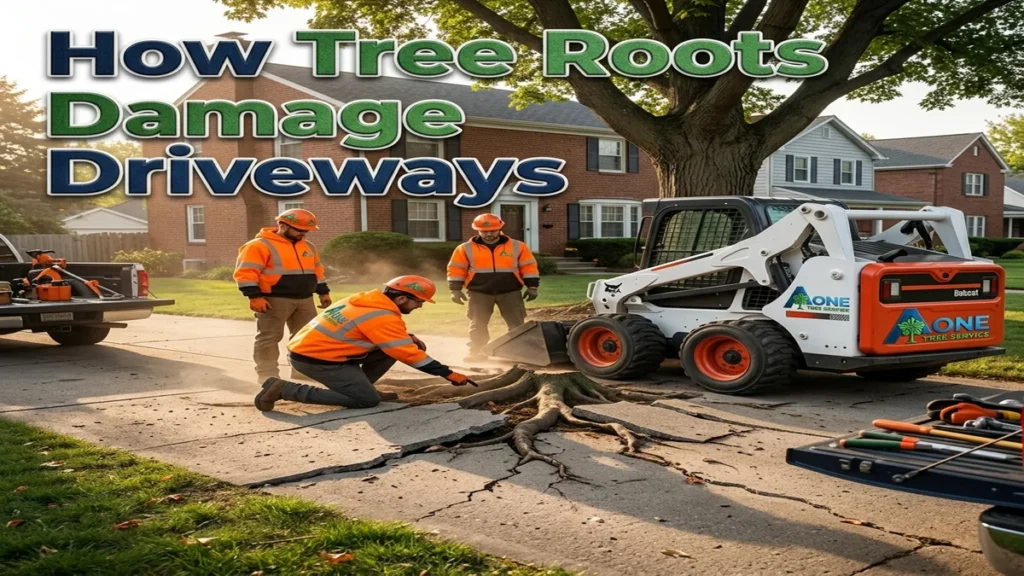
Tree roots damage driveways all over Rochester NY, and most homeowners don’t connect the cracked slab to the maple out front until the concrete has already lifted an inch or two. A tree you planted for shade can quietly turn into the most expensive thing in your yard, and the damage rarely stops at the pavement.
At A One Tree Services we get calls about this after the fact: a garage apron that no longer drains, a sidewalk square tilted like a ramp, a basement wall with a new hairline crack. Below is how the damage really happens, which trees cause it, and what to do before you spend money on concrete that will only get lifted again.
How Tree Roots Damage Driveways: What Is Happening Under the Slab
Roots don’t punch through concrete the way people picture it. What they do is thicken. A root that started out pencil thin grows wider every year, and if it sits right under a slab, that slab becomes the lid on a very slow hydraulic jack. The concrete has nowhere to go but up, so it lifts at one edge, cracks along the weakest line, and tilts.
Most of a tree’s feeding roots live in the top foot or two of soil. Under pavement, that soil is packed down hard, so roots look for the loose, damp, oxygen rich ground along the edge of the slab or just beneath the gravel base. The underside of a driveway is a surprisingly comfortable place for a root. It’s shaded, it holds moisture, and nobody disturbs it.
Once a crack opens, rain and snowmelt get in. More water means more root growth toward the crack, and the damage feeds itself.
Why Roots Head for Foundations, Drains, and Sewer Lines
A root isn’t hunting your house. It follows water and air, and a home happens to concentrate both. The soil beside a foundation stays damp longer than open lawn, especially under a downspout that dumps right at the wall or a sump discharge that spills onto the same patch of ground every storm.
Footing drains and the gravel around them are the easiest path of all. Rochester has heavy clay soil in many neighborhoods, and clay is dense and slow to drain. A loose gravel trench running beside the foundation is like a highway through it, so roots follow the trench and sometimes wrap the pipe inside.
Sewer laterals work the same way. A tiny leak at a joint puts out moisture and nutrients, a hair of a root slips in, and over a few seasons it fills the line. If your drains have started gurgling and there’s a big tree between the house and the street, that’s worth a look before you blame the plumbing.
Clay Soil and Freeze Thaw Cycles Make It Worse
Rochester winters add a second force on top of the roots. Water works into any crack, whether a root started it or ordinary settling did, and when it freezes it expands and pries the crack wider. Lake effect weather means we get plenty of cycles where it thaws by afternoon and freezes again overnight, and each cycle opens the gap a little more.
Clay holds water against the slab and the foundation instead of letting it drain away, so the freezing happens right where you least want it. A section of driveway that was lifted by a root last summer is also the section that collects meltwater this winter. By spring, a gap you could barely see in October can be wide enough to catch a shovel blade.
Which Trees Cause the Most Trouble Near Pavement
Some species are far more likely to show up in these stories than others. The usual suspects in Monroe County yards are the fast growing, shallow rooted shade trees.
- Silver maple: fast, brittle, and famous for thick surface roots that lift sidewalks and clog sewer lines.
- Norway maple: dense shade and a tight mat of surface roots that nothing else wants to grow through.
- Willow and poplar: thirsty trees that push roots a long way toward any water source, including pipes.
- Callery pear: common along newer streets and driveways, and prone to splitting as it ages, which is a separate problem from its roots but often shows up at the same address.
Oaks and many conifers send roots deeper and tend to be easier on pavement, though no large tree is harmless if it’s crowded against a slab. If you’re picking something new, our post on the best trees for Rochester NY properties covers species that behave themselves near hardscape.
Warning Signs to Check on Your Own Property
You don’t need special tools for a first look. Walk the property after a rain and again once the snow melts, and keep an eye out for the following.
- Slab edges that sit higher than the neighboring section, or that have tilted toward the house.
- Cracks that follow a line pointing back to a tree, getting wider as they get closer to it.
- Doors and windows that stick, or a new diagonal crack running from a corner of a basement window.
- Slow drains, repeated sewer backups, or a wet patch of lawn that stays soggy in dry weather.
- Roots showing at the surface, or a trunk flare that has crept right up against a retaining wall or step.
Our walkthrough on the signs of tree root damage around your home goes into more detail on what each symptom usually means. A crack alone doesn’t prove roots did it, and a foundation crack should always be looked at by someone who understands foundations. The tree is only one suspect.
Why Cutting One Root Rarely Solves It
Hacking out the root that lifted your driveway feels like the obvious fix. But a big structural root also anchors the tree, so cutting it close to the trunk can leave the whole tree leaning in the next windstorm. And the tree usually answers by pushing out new roots near the cut. Before anyone cuts anything, the whole tree needs to be assessed: its health, its lean, and how much of its root plate is already compromised.
Planting Distances That Keep Tree Roots and Driveways Apart
Prevention is cheaper than concrete. As a rough guide, large shade trees with spreading roots do best planted well away from the house, driveway, and any buried utilities, often 20 feet or more. Smaller ornamental trees can sit closer, sometimes 10 to 15 feet, because their root systems are modest. These are general starting points, and the mature size of the tree matters more than the sapling you’re holding.
A few other habits help. Plant on the lawn side of the driveway rather than hard against the edge. Mulch the planting area so roots have something loose to grow into besides the compacted soil under the slab. And before you dig for a new tree, a fence post, or stump work, call 811 through Dig Safely New York so buried lines get marked first.
If you’re stuck with a mature tree already close to the pavement, regular tree trimming keeps the canopy balanced and reduces the sail area the roots have to hold up in a storm. Pair that with watering during dry stretches, because a thirsty tree sends its roots farther looking for water. The Trees Are Good consumer site from the International Society of Arboriculture has solid general guidance on root care and watering.
When Removal and Stump Grinding Make Sense
Sometimes the honest answer is that the tree has to go. If a silver maple is already lifting a slab, cracking a patio, and sitting over a sewer line, repairing the concrete while the tree stays means paying for the same repair again in a few years. In that case tree removal is often cheaper than the long game.
Plan for the stump too. A stump left behind can keep sending up shoots, and its roots keep decaying in the same soil under your slab for years. Stump grinding takes the stump down below grade so you can reseed or lay new pavement over it. Large roots under hardscape decay slowly, so some settling afterward is normal, and it’s smart to wait before pouring new concrete over a freshly removed tree.
If you’re deciding whether it’s time, our guide on the signs a tree needs removal walks through the condition checks, and the tree removal cost breakdown explains what drives pricing. In older close in neighborhoods like Brighton and Pittsford, where large trees sit next to older driveways, the conversation comes up all the time. Our Pittsford tree service page has more on that kind of property.
Frequently Asked Questions
How close is too close to plant a tree near a driveway or house?
It depends on the species and its mature size. Large, shallow rooted shade trees generally belong 20 feet or more from pavement and foundations, while smaller ornamental trees can often go closer. Check the mature spread of the tree, not its size at the nursery.
Will cutting a root that is lifting my driveway kill the tree?
It can. Removing a small root far from the trunk is often survivable, but cutting large roots near the trunk, or taking roots from one side only, can seriously stress the tree or leave it unstable in wind. Have the tree evaluated before any cutting.
Can roots really get into a sewer line or footing drain?
Yes. Roots follow moisture and nutrients, and even a small leak at a joint can invite a fine root inside. Over time it thickens and can slow or block the pipe, which is why repeated drain problems near a large tree deserve a closer look.
Does removing the tree stop the damage?
It stops new root growth, but the existing roots decay slowly over several years, so some settling can continue for a while. Grinding the stump and waiting before you repair or repour the concrete gives the ground time to settle.
Is a cracked driveway always caused by tree roots?
No. Frost, poor drainage, a weak base, and ordinary age all crack concrete. Roots are a likely culprit when the crack runs toward a nearby tree and the slab has lifted instead of just settled. An on site look at the tree and the pavement settles it.
If tree roots damage driveways or walkways on your property, call us at (585) 888-9232 or request a free estimate. We’ll look at the tree and the slab together and give you straight options. Tree roots damage driveways slowly, so the sooner someone has a look, the more choices you have.