
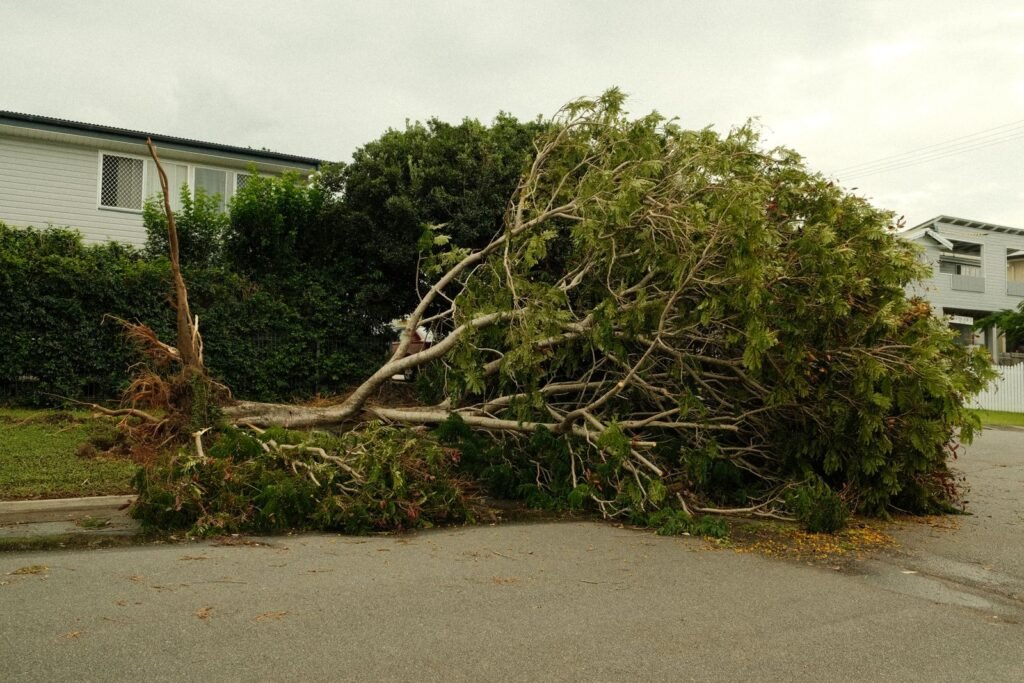
When a tree falls on a neighbor’s yard, the first question out of everyone’s mouth is who pays. The answer is usually less dramatic than people expect. A lake effect ice load or a hard spring thunderstorm can drop a silver maple across a property line in seconds, and A One Tree Services hears from homeowners on both sides of that fence the next morning, all wondering the same thing.
Quick note before we start. What follows is general information about how these situations tend to play out with standard homeowner policies. It is not legal advice, and every policy reads a little differently, so your own insurance agent has the final word on your coverage.
What Happens When a Tree Falls on a Neighbor’s Yard
Picture the morning after a wind event. Your Norway maple has split at a crotch and the top half is lying across your neighbor’s fence, maybe pinning a swing set or leaning on a shed. Your instinct says you own the tree, so you own the problem. Most of the time, that instinct is wrong.
With a typical homeowner policy, the person whose property got damaged usually starts with their own insurance. Your neighbor’s fence is repaired under your neighbor’s policy, and your garage roof is repaired under yours, even when the tree grew on the other side of the line. Insurers prefer this because it avoids a fault investigation after every storm. Each carrier pays its own customer, and if there is a reason to sort out who owes whom, the companies do that between themselves without the two of you going to court.
For a bigger picture on how carriers think about weather related losses, the Insurance Information Institute is a decent plain English place to read up before you call your agent.
Why Storm Trees Are Usually Nobody’s Fault
If a healthy tree comes down in a storm, insurers generally treat it as an act of nature. Nobody neglected it, nobody ignored a warning, and the wind simply won. That covers the large majority of storm claims around Monroe County, from a poplar snapped in a Greece lakeshore gust to a limb torn off a mature oak in Brighton.
This is the reason the default answer is “everybody covers their own damage.” If no reasonable owner could have prevented the failure, there is no one to blame. You can help a claim along by noting the conditions that day. Wind advisories, other trees down on the block, and a forecast from the National Weather Service Buffalo office all support the point that the weather, not neglect, caused the failure.
When Negligence Changes the Answer
The picture shifts when the owner knew, or reasonably should have known, that the tree was a hazard and did nothing. A trunk with a big cavity, a canopy that stayed bare all summer, a lean that grew worse each year, or a neighbor who asked you twice to deal with the tree and got shrugged off. In those cases, responsibility can move toward the tree’s owner, and their insurer may get involved.
If you want to know what the warning signs actually look like, our post on how to identify a hazardous tree walks through them. A mushroom shelf at the base, deadwood in the crown, and heaved soil on one side of the root flare are the ones we see most.
Looks Obvious Now Is Not the Same as Was Known Then
Hindsight makes every failed tree look like a time bomb. What matters to an adjuster is whether someone had real notice. If a tree next door worries you, say so in writing. A dated text or email beats a hallway conversation that two people remember differently, and it protects you whether you are the worried neighbor or the owner who acted on the warning.
The First Hour: What to Photograph and Write Down
Whichever side of the fence you are on, evidence collected in the first hour makes everything easier later. Before anyone drags a limb or fires up a saw, take photos from several angles. Capture the failure point, whether it is a snapped trunk or a root ball lifted out of heavy Rochester clay, because that shows whether the tree was already compromised underground.
- Wide shots and close ups of the tree, the break, and every damaged item, taken before cleanup
- The date, the rough time you found it, and what the weather was doing
- Any texts or emails about the tree’s condition, from either household
- A written estimate or invoice from whoever handles the tree removal, for the claim file
- A call to your agent before you agree to any casual cash settlement with a neighbor
That last point matters more than it sounds. A handshake deal at the property line can complicate a claim, and a few minutes with your agent first costs nothing.
Talking to the Neighbor Without Starting a Feud
Nobody asked for this, and the person next door is probably just as rattled as you are. Lead with facts. Tell them what came down, show them the photos, and say you are calling your insurance company. Skip any guessing about fault until an agent has weighed in. Most disputes that start when a tree falls on a neighbor’s yard fade quickly once both sides realize the first line of coverage is each person’s own policy. A plate of cookies has never hurt a claim either, though we would not put that in writing to your insurer.
Boundary questions deserve an early answer. On older streets in Pittsford, Brighton, and Fairport, where a century old oak can sit right on a fence line, nobody may know exactly where the trunk stands. A survey or old deed records can settle it fast, and it is far easier to sort out before a claim than during one.
Emergency Situations Do Not Wait for Paperwork
Ice storms are the classic example around here. Branches loaded with ice sag onto fences and wires overnight, and by sunrise the sound of cracking limbs has stopped but the danger has not. A trunk that has already let go can still shift when weight changes.
Insurance can be sorted out next week. A tree resting on a roof, hanging in a power line, or blocking the only way out of a driveway cannot wait that long. Safety comes first, and most insurers understand that. Photograph what you can from a safe distance, then get help.
Our crews handle emergency tree removal with spider lifts, rigging gear, and high capacity chippers, which matters when the tree is draped over a fence or garage in a tight backyard. If the damage reaches beyond one tree, our guide to what to do after storm damage in Rochester NY covers the wider cleanup. Never go near a limb that is touching a wire, and keep kids and pets well back.
Cutting Down the Odds Before the Next Storm
The cheapest claim is the one that never happens. A tree leaning toward the neighbor’s fence, carrying dead limbs, or ignored for five or six years is the kind that turns a windy night into a dispute. A professional look costs much less than a claim, and regular tree trimming takes out the dead and weak wood that tends to fail first.
It also leaves you a paper trail. If an invoice shows the tree was inspected and pruned last fall, you are in a far stronger spot than the owner who can show nothing. That habit is worth building on lots with mature trees close to a shared line, which describes a lot of Pittsford and Brighton. Town rules about removing or pruning certain trees vary, so check with your town code enforcement or building department before you cut anything near a boundary.
Frequently Asked Questions
If my tree falls on my neighbor’s shed, am I automatically responsible for the repair?
Not automatically. With most standard homeowner setups, your neighbor’s own policy responds to damage to their shed, whoever’s tree it was, unless there is clear evidence you knew the tree was hazardous and left it alone. Check the details with your neighbor’s agent, since carriers differ.
Do I have to pay to remove a tree that fell from my yard onto someone else’s property?
Often the removal of the fallen tree is handled as part of the damage claim on the property where it landed. Ask your own agent whether your policy covers removal at all, especially if part of the tree is still standing on your side of the line.
What if we cannot agree on whether the tree was dangerous beforehand?
Adjusters deal with this disagreement all the time. They usually ask for photos, earlier messages, and sometimes an assessment from tree care professionals. You rarely have to settle it between yourselves.
Should I remove the tree before or after I file a claim?
If it is an active hazard, make it safe right away and photograph everything first. If it is not urgent, call your agent before cleanup starts so they know what to expect. Most insurers understand that safety comes first after a storm.
Does it matter which side of the line the trunk grew on?
It can come up, especially with a trunk that straddles the boundary. It is usually less important than whether the tree was healthy and whether either owner had reason to see trouble coming. Your agent can explain how much weight it carries under your policy.
If a tree falls on a neighbor’s yard, a calm conversation, good photos, and a quick call to your agent solve most of the problem. When you want the tree itself handled safely, ask for a free estimate, and see our gallery for the kind of work we do around Rochester.