Land clearing services turn a tangle of brush, saplings, and half dead trees into a lot you can actually build on, park on, or farm. Done well, the job takes a few days and leaves the ground ready for the next step. Done badly, it leaves buried stumps, hung up trunks, and rutted ground that costs more to fix than it did to make.
This guide explains how land clearing works around Rochester and Monroe County, what decisions come up before the first tree comes down, and how to get the lot you imagined. It is written for homeowners planning a driveway, a garage, a pool, or a new house, and for anyone who has inherited an overgrown back lot and wants to know where to begin.
What Land Clearing Services Include
Clearing means taking out the trees, brush, and stumps that stand between you and your plan. A typical job can involve several steps, and which ones you need depends on the lot.
- Tree removal. Cutting and rigging down trees, big and small, including trees in tight spots near buildings or lines. See our tree removal service.
- Brush and sapling clearing. Taking out the thick undergrowth, buckthorn, and volunteer trees that fill up fence lines and old fields.
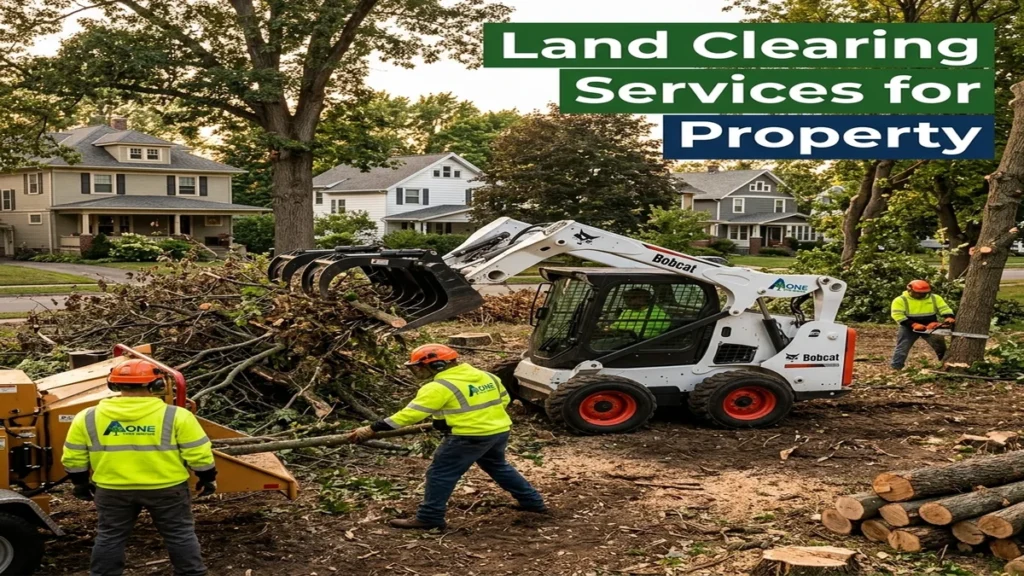
- Chipping and hauling. Running limbs and brush through high capacity chippers, then moving logs and debris with a bobcat loader.
- Stump grinding. Grinding stumps below the surface so the area can be graded, planted, or paved. Learn more about stump grinding.
You can see how we describe the work on our land clearing page, and in practice every job is a mix of those pieces that depends on what the lot looks like when we walk it.
Start With a Walk of the Property
Before any saw starts, a crew should walk the lot with you. You are looking for what stays, what goes, and what is in the way.
Mark the boundaries so the crew knows where your property ends. Point out the trees you want to keep, such as a nice oak or a screen of spruce along the neighbor’s line. Show where the driveway, house, septic, or well will go, if you know. Mention gates, soft ground, fences, culverts, and anywhere equipment might get stuck.
A good plan also looks at what you cannot see. Overgrown lots often hide old fence wire, buried debris, and rotted stumps that look solid. That is one reason a free on site estimate beats a number quoted from a photo.
Land Clearing Services and the Rules You Should Check
Before cutting, find out what rules apply to your land. We are not going to quote you a specific rule, because requirements vary by town and by property. Some towns require permits for removing certain trees or for clearing a lot of land. Some parcels contain wet areas, steep slopes, or protected areas that change what you can do.
Start by calling your town code enforcement or building department, and ask what you need for your project. The Monroe County website is a starting point for county services, and the NYS DEC forests and trees page has information on state forests and trees. For more on removal rules, see our post on whether you need a permit to remove a tree in Rochester NY.
Also call 811 before any digging or grinding near the area. Dig Safely New York arranges for utilities to mark buried lines, and it is a free and easy step that protects everyone on site.
How the Work Gets Done on a Real Lot
On an open lot with good access, the crew works from the outside in. Dead and hazardous trees come down first because they are the most dangerous. Large trees get felled or taken apart in sections, depending on how much room there is. Our climbing and rigging gear lets us lower pieces over a fence or around a structure without letting them drop.
Where access is tight, such as a backyard behind a house or a lot surrounded by neighbors, a spider lift can reach where a bucket truck cannot. A tracked aerial lift fits through a gate and over lawn without tearing it up, and it allows the crew to work high in a tree while staying on the ground.
Brush goes to the chipper. Logs get stacked or hauled. A bobcat loader moves material to a pile or truck, and stumps get ground out where they interfere with the plan. The crew works in orange high visibility gear so everyone on site can see them.
Stumps: Grind, Pull, or Leave
Stumps are the part of clearing most people forget about, and they decide whether the cleared area is usable. A stump left in the middle of a future lawn becomes a mower hazard. A stump under a slab can rot and settle.
Grinding is usually the best choice on a residential lot. It takes the stump below ground without digging a crater. If you plan to build over the spot, tell the crew so they can grind deeper. For help on when to grind, see when you should grind a tree stump.
Protecting the Trees You Want to Keep
Clearing is not all or nothing. On many lots the smartest plan is selective: take out the weak, crowded, and dead, and keep the healthy trees that give you shade and privacy. The trick is that trees next to a cleared area take a hit. Their roots get cut, their trunks get exposed to new wind, and ground compaction from equipment can slowly stress them.
Ask the crew to flag the keepers before work starts, and keep heavy equipment out of their root zones. A tree that was sheltered in the woods may also be more likely to lose limbs once its neighbors are gone, so a little thinning and trimming afterward can help. Our tree trimming service handles that follow up.
Time and Cost: What to Expect
Most clearing jobs are not predictable by acreage alone. A half acre of open brush may go faster than a small lot packed with mature oaks next to a house. What drives time and cost is the number and size of trees, the density of brush, access for equipment, what is underneath, and whether stumps are ground.
We cannot tell you a price without seeing the lot, which is why we offer a free estimate on site. For general background, our posts on how much tree removal costs in Rochester NY and how long tree removal takes explain the same factors in more detail.
Common Land Clearing Situations in the Rochester Area
Around Rochester, a few jobs come up again and again.
- Building lots in growing areas. Fast changing neighborhoods like Victor have lots where trees and brush need to come out before foundations can go in.
- Large rural style lots. Places like Hilton, Chili, and Mendon often have bigger parcels with wooded corners or old overgrown pasture.
- Driveways and access paths. Cutting a lane to a back lot, a barn, or a shed.
- Yard expansions. Opening up a shaded yard for a pool, patio, or garden.
- Overgrown and neglected lots. Taking back a property after years of neglect.
If you are not sure whether your property falls under one of these, the service area page lists every town where we work.
How to Prepare Before the Crew Arrives
- Check with your town about permits and rules for your project.
- Call 811 if there will be any digging or stump work.
- Mark property lines, trees to save, and underground items like septic, wells, and irrigation.
- Move vehicles, trailers, and anything else out of the work area.
- Tell the crew about gates, soft spots, and any hazards you know of.
- Decide what you want done with the wood chips and logs.
Frequently Asked Questions
What are land clearing services?
Land clearing services remove trees, brush, and stumps from a property so it can be built on, planted, or used. A job can include tree removal, chipping, hauling, and stump grinding.
Do I need a permit to clear land in Monroe County?
It varies by town and property, and some areas have additional rules. Check with your town code enforcement or building department before work starts.
Can you clear a lot with tight access?
Often yes. Spider lifts are tracked aerial lifts that fit in tight backyards, and rigging gear lowers heavy sections under control. A crew can tell you what works after seeing the site.
What happens to the wood and brush?
Brush goes through chippers, and logs can be hauled away or left for firewood depending on what you want. Tell the crew your preference during the estimate.
Should stumps be ground during land clearing?
Usually yes if you plan to build, plant, or mow the area. Grinding removes stumps below the surface without a large hole, though deeper grinding may be needed under future structures.
How do I get an estimate for land clearing?
Call (585) 888-9232 or use the contact page. We offer free estimates and look at the lot on site before giving you a plan.
If you are planning a build, a driveway, or an overgrown lot cleanup, land clearing services start with a conversation and a walk of the property. Call (585) 888-9232 or request a free estimate, and we will show you what the job involves from the first tree to the last stump.