
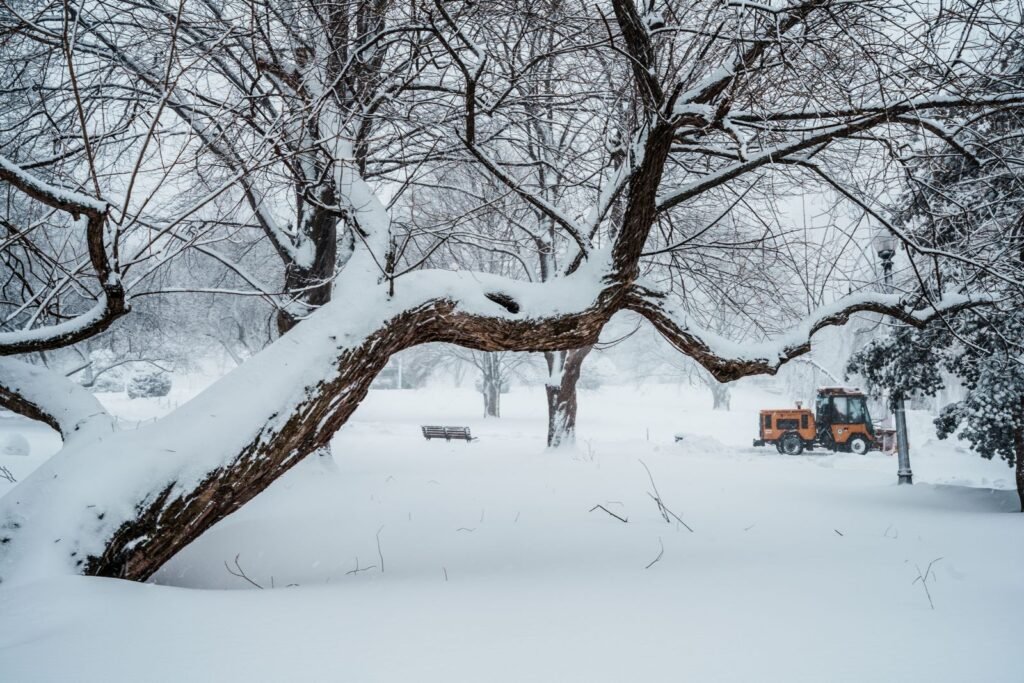
Is it safe to remove a tree in winter? In most cases, yes, and for plenty of Rochester properties winter is one of the better times to get it done. The question still shows up every year right after the first hard freeze, usually bundled with a few assumptions about frozen soil, dead lawns and bare branches. Some of those assumptions run exactly backward. Here is what holds up on real jobs around Monroe County, and where winter genuinely changes the work.
So, Is It Safe to Remove a Tree in Winter?
Safe depends on three things: the tree, the ground and the crew. A leaning silver maple behind a garage is not safer in July than in January. A willow with a rotten trunk is not more stable once the snow load arrives. What changes with the season is how the crew plans access, footing and rigging, not whether the work can be done at all.
The honest version is that winter removal is routine tree work with a few extra steps. Snow gets shoveled away from the drop zone, ice gets treated as a hazard, and the day gets planned around daylight. Nothing about that is exotic. It is the same job done by people who expect Rochester weather.
Myth One: Frozen Ground Stops the Work
This is the one we hear most, and it is close to the opposite of the truth. Rochester sits on heavy clay in many neighborhoods, and clay in a wet spring is miserable. Tracked equipment rolls across it and leaves ruts that last until August. Frozen ground carries weight far better, so a bobcat loader or a spider lift can set up without sinking.
A chainsaw does not care that the wood is cold. What makes a removal hard is the size of the tree, the way it leans, and how close it stands to a roof, a fence or a wire. The thermometer barely enters into it. If you have been told the job has to wait for a thaw, ask for the specific reason, because the ground itself is rarely it.
Myth Two: Winter Removal Wrecks the Lawn
Dormant grass handles traffic much better than a lawn that is actively growing. A frozen or snow covered yard can take a crew walking back and forth with brush and rigging lines, while the same traffic in July can scar green turf and compact it for the rest of the season. Shrubs and perennial beds are also asleep or tucked under mulch and snow, which gives them a layer of protection they never get in summer.
None of this means a yard comes through completely untouched. Heavy equipment needs a planned path, and plywood or mats may make sense near a septic area or a soft corner. The point is simply that winter is not harder on a property than any other season, and in some cases it is gentler.
Myth Three: You Cannot Judge a Tree Without Its Leaves
Homeowners often assume a tree is easiest to evaluate when it is full and green. People who work in the canopy see it differently. Without leaves, cracks, cavities, included bark between two trunks, and dead limbs stand out against the sky. A dead branch hiding in summer foliage can be nearly invisible from the ground, and the same branch is obvious in December.
That is why late fall and winter are good months for a hard look at a questionable tree. If you are unsure about one, our post on the signs a tree needs removal lists the red flags worth checking, and the guide to how to identify hazardous trees goes deeper on structure and decay.
Myth Four: A Dead or Leaning Tree Can Wait Until Spring
This is the myth that costs people the most. A compromised tree does not pause for the season. Ice builds weight on weak limbs, freeze and thaw cycles pry at cracks that already exist, and wet snow loads the canopy of a tree that was marginal in September. Rochester winters are long, and a tree that was borderline in fall has months of lake effect weather to fail in before anyone calls it spring.
Waiting Has a Cost Too
If a tree is leaning more than it used to, shedding bark in sheets, or standing dead over a roof, driveway or play area, treat the calendar as irrelevant. A scheduled winter removal on a calm day is almost always easier and safer than an emergency call in the middle of an ice storm. Our write up on how winter weather damages trees in Rochester explains why.
What Winter Does Change About the Job
Here is where we stay honest. Winter does add things to think about. Ice on a trunk makes climbing and rigging slower and more deliberate. Snow can hide stumps, buried irrigation heads and uneven ground, so someone walks the site before equipment moves. Daylight is short in December, which affects how much work fits into one visit. A large tree that might take a single day in October could be planned across two in a snowy week.
Tight backyards are where equipment choice matters most. A spider lift is a tracked aerial lift that fits through a gate and works from a small footprint, which helps when a snowbank has narrowed the path. Crews also stage chippers and loaders where they will not block a plowed driveway. These are normal parts of planning, and they are the reason an experienced crew will ask you about gates, fences, buried lines and where the snow gets pushed.
What a Scheduled Winter Removal Looks Like
A calm January removal usually follows a simple rhythm. You call, we look at the tree and the site, and you get a free estimate with the plan in plain language. On the day, the crew walks the yard, flags anything buried under snow, sets up the drop zone and ropes, and starts at the top or the trunk depending on what is nearby. Limbs go through the chipper, logs get cut to length, and the loader moves material out. Then the yard gets raked and cleaned up.
A good test for whether it is safe to remove a tree in winter is to ask the crew how they would handle your specific yard. If the answer covers access, footing, the neighbor’s fence, the wire at the corner and where the debris goes, you are talking to people who have done it before. If the answer is a shrug and a price, keep looking.
Neighbors, Stumps and Dormancy
Plants nearby are one more quiet advantage. When surrounding trees and shrubs are dormant, cutting and equipment traffic disturb them less because nothing is actively pushing sap or new growth. It is a smaller factor than footing or visibility, but it adds up.
Stumps are a separate conversation. A stump can be ground in winter as well, although frozen soil around it means the crew works a little differently, and you will want the grinding spots flagged before snow buries them. You can read more on the stump grinding service page, and the planning questions are similar to removal. If you are curious how long a job runs, see how long tree removal takes.
When Winter Is the Wrong Moment
There are days when routine work should not happen. An active ice storm, sustained high wind, or a whiteout that hides the drop zone is not the time for planned removal, and a responsible crew will reschedule. Emergencies are the exception: a tree on a roof or a line is handled as a hazard, not a convenience. Our emergency tree removal page explains how that works.
For everything else, book it like any other job. Power lines, houses and tight spaces make professional rigging worth it in any month, and the tree removal service page covers what a standard visit looks like. If you want a sense of timing for non urgent trees, the post on the best time to trim trees covers the seasonal side of pruning, which differs from removal.
For general background on tree safety and storm risk, the International Society of Arboriculture consumer site and the National Weather Service winter safety page are both worth a read before the snow flies.
Frequently Asked Questions
Does frozen ground make tree removal harder?
Usually the opposite. Firm, frozen soil holds equipment weight better than soft spring clay, which reduces ruts and the chance of getting stuck. Tree size, lean and the distance to structures matter far more than the temperature.
Can a stump be ground when the ground is frozen?
Yes. Frozen soil can slow the work slightly, and snow can hide the stump, so mark it before the storm. The crew adjusts the approach, but winter does not prevent stump grinding.
Is winter removal riskier for the crew than summer removal?
It brings different considerations, mainly icy footing, wet rope and shorter daylight. Experienced crews plan for those, and they will postpone routine work during an active ice storm or strong wind.
Will winter tree removal damage my lawn?
Often less than summer removal. Dormant turf under frost or snow tolerates foot traffic and equipment better than growing grass. Your crew should still plan the path and use ground protection where the yard is soft.
Should I wait until spring to remove a dead tree?
Not if it stands over a house, driveway or walkway. Dead and structurally weak trees keep failing through winter, and a calm scheduled day is safer than an emergency call during a storm.
If you are still asking yourself whether it is safe to remove a tree in winter, the quickest answer comes from someone standing in your yard. Every project starts with a free estimate, so contact A One Tree Services or call (585) 888-9232, and see recent work in the project gallery.