DIY vs professional tree trimming is a decision most Rochester homeowners face the first warm Saturday of spring, with a pruning saw in one hand and a ladder leaning against a maple. Plenty of tree work is perfectly reasonable to do yourself. Some of it is how people end up in the emergency room or with a tree that never recovers. At A One Tree Services we get called after both outcomes, so here is an honest line between the two.
We are not here to scare you off your loppers. We just want you to know which jobs sit on which side of that line before you climb anything.
Jobs That Are Fine to Handle Yourself
A fair amount of routine care is well within reach. Branches you can cut from the ground, generally no thicker than a finger or two, are low risk with sharp hand pruners or loppers. Suckers sprouting at the base of a trunk, a dead twig or two on a small ornamental, and light shaping of young shrubs all fit the same pattern.
The rule underneath all of them is simple. Your feet stay on the ground, and nothing you cut is big enough to hurt you or break something if it falls wrong. The moment a job needs a ladder, a chainsaw, or an overhead reach with a heavy tool, you have changed categories, even if the branch itself looks small.
Why a Ladder Changes Everything
A ladder seems like a way to add a few feet of reach. In practice it adds a fall risk to a cutting job. You are balanced on an unstable surface, often on soft ground or near a root flare, using both hands for something other than holding on. A branch that shifts, a saw that binds, or one awkward reach is enough to put you on the ground, and a fall from even a modest height can do real damage.
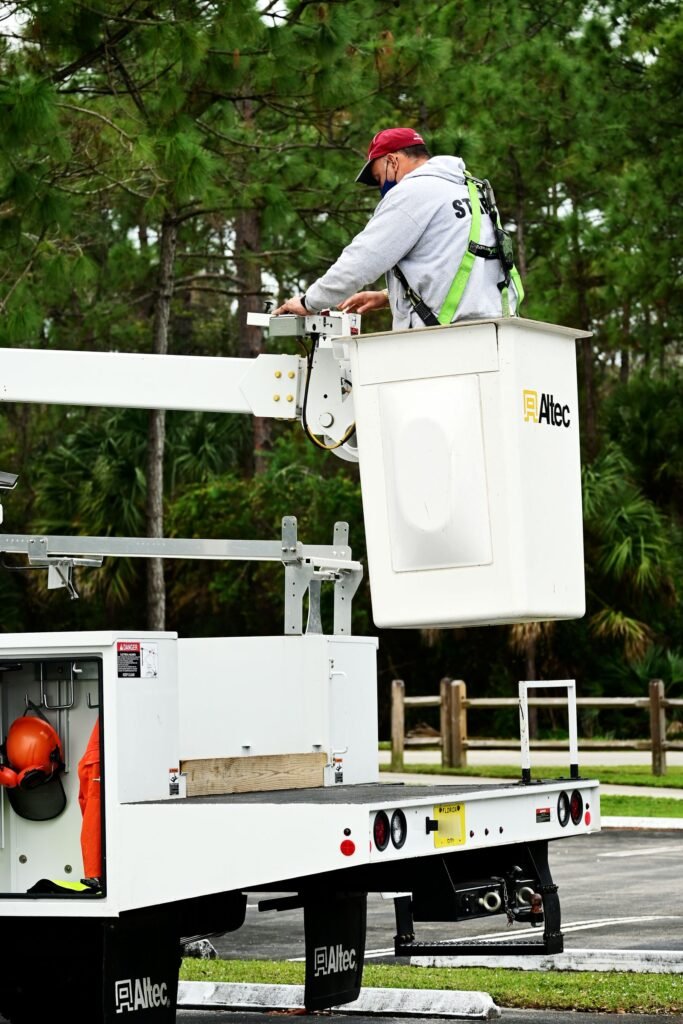
Professional crews solve this with different gear altogether. They climb with rated ropes and harnesses, or they work from a lift. Our spider lifts, for example, are tracked machines that fit through a backyard gate and hold the operator steady while both hands do the cutting. A homeowner on a straight ladder has no backup if something goes wrong.
A Quick Reach Test
If you cannot reach the branch with a pole pruner while standing on solid ground, treat it as outside DIY territory. That is the point where the tools stop being “safe with basic care” and start being “hazardous without training.”
Power Lines Turn a Yard Chore Into an Emergency
Anything growing in or near an overhead line is a job for professionals, full stop. Electricity can travel through a wet branch, a metal ladder, or a pole saw, and you do not need to touch a wire to be in danger. Rochester gets plenty of wet snow and rain, and wet wood conducts far better than dry.
Clearance around utility lines is specialized work with its own procedures. If a limb is creeping toward a line, make a phone call. Do not schedule it as a weekend project.
Large Limbs and Chainsaws: Risks You Cannot See Until They Bite
A chainsaw is a different animal from hand pruners. A heavy limb can carry stored tension or compression from the way its weight hangs, so a single cut can make it snap, twist, or kick in a direction that is hard to guess unless you have been trained to read the wood. Pros plan cuts in sequence for exactly that reason, removing weight first and finishing last.
Where the limb lands is the other half of the story. A branch that looks like it will clear the fence can swing wildly once gravity and the rest of the tree get involved. Crews use rigging lines and directional cuts, often with a second person controlling the drop, because “it looked like it would land fine” is what people say a second before it doesn’t. Over a driveway, a deck, or a neighbor’s fence line in Webster or Greece, that second matters.
Bad Cuts That Look Fine Today and Hurt for Years
Not every risk is physical. Some of the worst DIY damage does not show up for years. A flush cut, made tight against the trunk, removes the branch collar, the swollen ring where a tree seals its own wounds. Without it the wound struggles to close and decay creeps in.
Topping is the other classic. Chopping main limbs back to stubs looks like a quick way to shrink a tree, but it triggers a thicket of weak regrowth that breaks more easily than the original wood. A topped tree often needs years of corrective work to rebuild a stable shape. Our post on the benefits of professional tree trimming explains why technique matters as much as the decision to cut. The International Society of Arboriculture also publishes pruning guidance, and reputable tree care companies follow industry pruning standards.
What a Professional Brings Beyond the Saw
Many homeowners price DIY vs professional tree trimming by comparing a saw rental to a crew’s estimate. That math leaves out the cost of a fall, a damaged roof, or a tree weakened by bad cuts, which is where the real difference shows up.
Equipment is only part of it. A crew is also reading the tree: which branches carry structural weight, which are hollowed by decay you cannot see from the lawn, and how the canopy will respond to what comes off. That judgment is a big part of what you are paying for, not just the cutting.
- An eye for internal decay, cracks, and weak branch unions before they fail
- Rigging and directional cutting to control exactly where a limb goes
- A fully insured crew, so a mistake on a roof or fence is not your bill
- Cut technique that helps the tree close its wounds and stay healthy
- Climbing and rigging gear, spider lifts, and chippers sized for the job
If you are shopping around, the Trees Are Good consumer site has a plain checklist for choosing a tree care company, and it applies to any company you consider, including us. Ask about insurance, ask how the crew plans to do the work, and be wary of anyone who wants to top your tree.
That insurance point deserves a moment. If a DIY cut sends a limb through a roof or a neighbor’s fence, the repair lands on you. Hiring a fully insured crew shifts that exposure onto people who carry coverage for exactly that scenario, which counts for a lot when the job involves real height.
DIY vs Professional Tree Trimming: A Four Question Check Before You Start
Ask yourself a few honest questions. Do I need a ladder to reach it? Is it thicker than my wrist? Is it anywhere near a wire? Am I planning to use anything other than hand tools? A yes to any of them is a good reason to pick up the phone. None of those questions are about skill. They are about what happens if the cut goes differently than planned.
If you cannot tell which side of the line a tree falls on, our tree trimming crew will take a look and give you a straight answer, including telling you when it is fine to handle yourself. When a tree has moved past trimming into tree removal territory, we handle that too. Homeowners in Henrietta and Gates often call us after eyeing a tree and wanting a second opinion before reaching for a chainsaw. If you are really trying to decide whether a tree needs a trim or something bigger, start with our guide to identifying a hazardous tree.
Frequently Asked Questions
In DIY vs professional tree trimming, what size branch is actually safe to cut myself?
Branches under about two inches across that you can reach from the ground with hand pruners or loppers are reasonable for most homeowners. Anything that needs a ladder or a chainsaw moves into a different risk category no matter how thick it is.
Is it really that dangerous to use a chainsaw on my own tree?
It can be. Much of the risk comes from unpredictable wood tension and kickback, not from the saw malfunctioning. Training reduces that risk a lot, and a first time user on a large limb does not have that margin.
Can I trim branches that are close to a power line but not touching it?
No. Electricity can arc across a short gap, especially with wet branches or metal tools involved, so closeness alone is reason enough to call a professional.
If I make a bad cut, will the tree recover?
Often yes, since trees are resilient. A flush cut or topping can still leave a tree open to decay for years and permanently change its shape and strength. It is rarely a one time cosmetic mistake.
How do I know if a simple trim is actually a bigger job?
If the limb is thick, high up, near a structure or wire, or the tree shows decay, cracks, or dead wood beyond the piece you plan to cut, get a second opinion. A quick professional look costs far less than fixing a mistake.
When you weigh DIY vs professional tree trimming, let the size of the limb, the height, and the neighbors on the other side of the fence make the call. For a free estimate and an honest opinion, contact A One Tree Services or call (585) 888-9232.