Professional tree removal matters because a tree is heavier, more unpredictable, and closer to your house than it looks from the patio. A mid sized maple can weigh several tons, and all of that weight is held up by a trunk, a root system, and tension in the wood that you can’t see from the ground. When a removal goes wrong, it goes wrong all at once.
We get calls every year from homeowners who started the job themselves, usually on a Saturday with a borrowed saw, and ended up with a limb through the garage roof or a trunk hung up in a neighbor’s tree. This post isn’t meant to scare anyone. It’s meant to explain, in plain terms, what a professional crew brings to the job and when it makes sense to call one.
Why Professional Tree Removal Matters More Than It Looks
Dropping a tree sounds simple: cut a notch, cut the back, and it falls the way you aimed. In a forest with open ground in every direction, that’s close to true. In a Rochester backyard, you have a house, a fence, a neighbor’s yard, a power line, and a shed all inside the fall zone. The tree has to go somewhere, and in most cases the answer is not “down in one piece.”
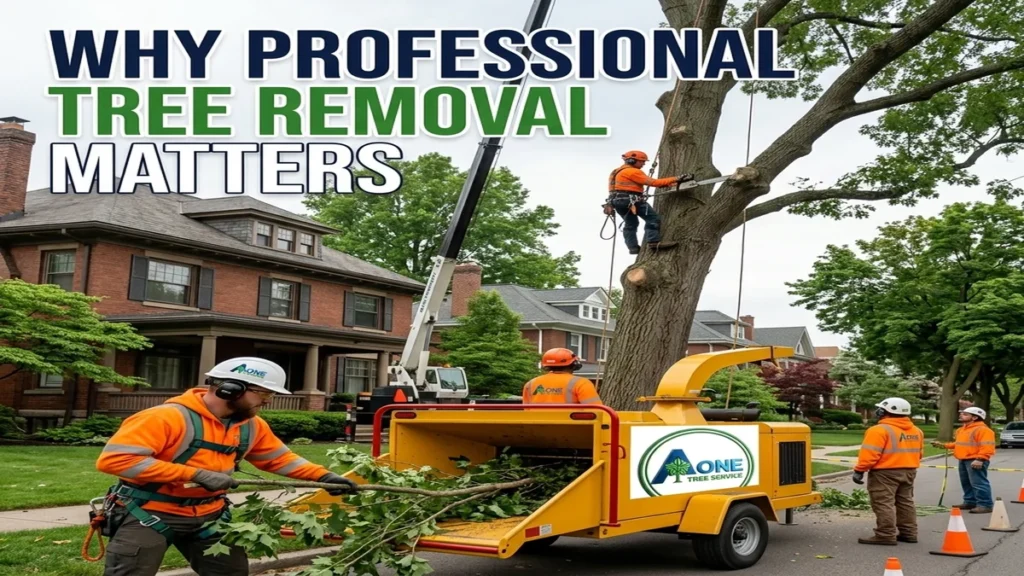
That’s why professional crews take trees apart section by section. A climber or a lift operator removes the top first, ties each limb or log to a rigging line, cuts it, and lowers it under control. Every cut changes how the rest of the tree balances. Knowing which cut to make next, and which one to avoid, is the part you can’t learn from a video, and it’s the core reason why professional tree removal matters.
What DIY Removal Really Risks
People who do their own removals are rarely careless. They are usually capable and handy, and the first few cuts go fine. The trouble comes from the situations that don’t look dangerous until they are. Here are the ones we see most often:
- A ladder placed on soft lawn that shifts while a chainsaw is running
- A leaning tree that kicks back off the stump or twists as it falls
- A cut limb that swings into a power line, a window, or a car
- A trunk that hangs up in another tree and can’t be brought down safely with hand tools
- A hollow or rotten trunk that fails halfway through the cut, with no warning
Chainsaws add their own hazards, especially above shoulder height and in awkward positions. Our post on DIY versus professional tree trimming goes deeper on those risks, and the same logic applies even more strongly to a full removal.
Equipment That Changes the Job
A big part of the value is the gear. Our crews work with climbing and rigging equipment that lowers sections gently rather than letting them crash. For backyards that a bucket truck can’t reach, we use a spider lift, a tracked aerial lift that fits through a gate and works on soft ground without tearing it up. A high capacity chipper handles the brush on site, and a bobcat loader moves logs and clears the lawn when the work is done.
Think about the typical Rochester situation: an old silver maple in a narrow yard in Brighton or Gates, with a garage on one side and a fence on the other. No homeowner can safely rig and lower a trunk that size with a rental saw and a rope. A crew that does it every week can, and they’ll finish in hours what might take you a weekend, if you could do it at all. Our post on how long tree removal takes explains what the timeline looks like for different jobs.
Insurance, Liability, and Why “Fully Insured” Matters
When a tree service damages property or someone gets hurt, who pays? That question is the reason you should ask every company you consider whether they’re fully insured. A One Tree Services is fully insured, and any reputable contractor will confirm theirs without hesitation. If a company dodges the question, move on.
When you do it yourself, you carry the risk yourself. A homeowners policy may or may not respond to a self inflicted accident, and the rules differ from policy to policy. The Insurance Information Institute is a good, neutral place to learn how homeowners coverage generally works before you decide, and your agent can tell you what applies to your policy.
Power Lines, Utilities, and Underground Hazards
Trees and wires live together all over Monroe County, and branches that touch a line can carry current to the ground. Never prune or cut anything near a service line yourself. If a tree is touching one, call your utility. For the ground itself, call 811 before any stump work or digging so underground lines are marked. The Dig Safely New York site explains how.
Reading the Tree Before the First Cut
Part of what a trained crew does, before the saw starts, is read the tree. Which way does it lean? Is there rot in the trunk, a cavity, or a split at the fork? Is the wood under tension from wind or ice damage? Dead ash trees, for example, become brittle, and emerald ash borer has left many ash trees in the area weakened. A limb that looks sound can shatter under a saw, and that kind of surprise is how people get hurt.
If you’re not sure whether a tree even needs to come down, our guide on the signs a tree needs removal walks through the warning signs. The International Society of Arboriculture’s ISA site and its consumer page, Trees Are Good, have helpful background on tree health and hiring.
Protecting Your Lawn, Roof, and Neighbors
A good removal isn’t just about getting the tree down. It’s about leaving everything else the way you found it. That means protecting the lawn, the roof, the fence, and the neighbor’s side of the property line, then cleaning up the debris, chips, and sawdust. We plan the work around those priorities and walk the site with you before we start so we agree on what’s coming down and where the equipment goes.
After the trunk is gone, most people want the stump gone too, and our stump grinding service can take care of it on the same visit or later. If you want to understand what a job involves from the first call to the last rake stroke, our tree removal page lays out the process.
What About Permits and Rules?
Some towns and some situations have rules about removing certain trees, and they vary from town to town in the Rochester area. Before any removal, it’s wise to check with your town code enforcement or building department, particularly for trees near a property line, in a right of way, or in a historic area. Our post on whether you need a permit to remove a tree in Rochester NY goes through the questions to ask.
How to Choose a Tree Company You Can Trust
You don’t need to be an arborist to vet a contractor. A few simple questions weed out most of the problems:
- Will someone come out to look at the tree and give a free estimate on site?
- Is the company fully insured, and will they tell you so plainly?
- Does the estimate say what’s included, such as cleanup, chipping, and stump work?
- Do they work with the right equipment for your yard, rather than improvising?
- Are they willing to explain the plan, including what could go wrong?
Be cautious about anyone who knocks on your door right after a storm and pushes for a quick yes. For cost context, see our post on how much tree removal costs in Rochester NY, and for more reasons homeowners lean on pros, read why Rochester homeowners choose professional tree services.
Frequently Asked Questions
Can I remove a tree myself to save money?
Small, accessible trees can sometimes be handled by a skilled homeowner, but anything tall, leaning, near a structure, or close to wires is a different matter. The cost of a mistake can far outweigh the savings.
What equipment does a professional crew use?
Our crews use climbing and rigging gear, spider lifts for tight backyards, bobcat loaders, and high capacity chippers. The equipment lets us take trees down in controlled sections and clean up with minimal damage to the lawn.
Is A One Tree Services insured?
Yes, A One Tree Services is fully insured. You should ask any tree company to confirm their insurance before work begins.
How do I know if a tree needs to be removed?
Common warning signs include dead branches, a leaning trunk, cracks or hollow areas, fungus at the base, and damage from storms or pests. A free on site estimate is a simple way to get a professional opinion.
Do I need a permit to remove a tree?
Rules vary by town and by the situation, so check with your town code enforcement or building department before work begins. We can talk through what to ask when we visit for the estimate.
What should I do if a tree is on my house or near a power line?
Stay away, keep others away, and call 911 or your utility if a wire is involved. Then call our 24/7 emergency line at (585) 888-9232 so a crew can make the scene safe.
That’s why professional tree removal matters: it keeps your family, your house, and your neighbors out of harm’s way. If you have a tree that worries you, call (585) 888-9232 or request a free estimate through our contact page, and for urgent situations see our emergency tree removal service.