Tree trimming protects your roof from a slow kind of damage that most homeowners never connect to the tree out front. It isn’t just the dramatic limb that comes through the shingles in a storm. It’s the daily scrape of a branch in the wind, the gutter that fills with seed pods, and the shade that keeps one slope damp all spring.
Here in Rochester, a roof has a hard enough life with lake effect snow, freeze and thaw, and summer thunderstorms. Add a mature maple hanging over it and you’re asking those shingles to handle a lot more. Here’s how branches wear on a roof, what trimming does about it, and how we handle the work safely when the branches are right above a home.
How Branches Wear Down Shingles Over Time
A branch that touches a roof doesn’t need a storm to do harm. Each breeze moves it a fraction of an inch back and forth, and over a few seasons that motion sands away the granules that protect asphalt shingles from sun and water. If you’ve ever noticed a bald stripe of shingle where a limb has been resting, or found grit in your gutter downspout, that’s what you’re looking at.
Smaller twigs and leaf clusters do their own version of this, and they leave behind stains. Heavy limbs add weight and a leverage point, so in a strong wind they can lift and crack shingles at the edge. This kind of wear is slow, and that’s why it gets ignored until the roof is due for replacement years before it should be.
Gutters, Debris, and the Water Problem
Leaves, needles, twigs, and flower petals pile up in gutters and valleys, and a damp mat of debris on a roof can hold moisture against the surface for days. Clogged gutters overflow down the siding and soak the fascia, and in winter they feed ice that builds along the eaves. A tree overhanging a roof dumps far more material than one set back from the house.
Trimming the branches that overhang the roofline reduces what lands there. This is one more way tree trimming protects your roof: it won’t replace gutter cleaning, but it can cut the frequency of it, which is no small thing if your gutters are two stories up. The National Weather Service winter safety page is a useful reminder of what Rochester winters can do, and ice loads on a roof with a clogged edge are part of that story.
How Tree Trimming Protects Your Roof in a Storm
Storm damage is the reason most people call us. Winds off Lake Ontario push on every limb, ice coats them until they sag, and a wet, leaf covered branch catches the wind like a sail. A dead or weakly attached limb above a roof is a falling hazard waiting for a trigger.
Trimming helps in three ways. First, taking out dead and cracked wood removes the branches most likely to come down. Second, shortening or thinning long limbs that reach over the house reduces the load and the leverage in a gale. Third, a properly pruned crown lets wind pass through rather than pushing against a solid wall of leaves. Our post on tree safety tips before heavy snowfall shows how to apply the same thinking in the hours before a big snow, and we cover the broader benefits in benefits of professional tree trimming.
Shade, Moss, and Slow Roof Rot
A roof slope that never dries out grows moss and algae, and it holds moisture where shingles and underlayment are trying to stay dry. Shade from a dense canopy can contribute, especially on north facing slopes. The answer isn’t to strip every tree. Some shade lowers cooling costs and keeps a yard pleasant. Thinning the canopy so that sun and air reach the roof for part of the day is often enough.
If you’re not sure whether the green streaks on your shingles are a cosmetic problem or something worse, have a roofer take a look. What we can tell you is whether the trees around the house are contributing and how much of the crown would need to come out to make a difference.
Squirrels, Raccoons, and the Branch Bridge
A branch that touches or hangs close to a roof is a highway for squirrels, raccoons, and other climbers. They go from limb to eaves to a loose soffit or vent, and once they find a gap, they’re in the attic. Clearing a gap between the tree and the house is one of the simplest ways to discourage that. It isn’t a guarantee, and you should still look for openings in the roofline, but it removes the easy route.
How Much Clearance Is Enough?
There isn’t a single number that applies to every tree and every house. A common rule of thumb among tree care companies is to keep branches a few feet clear of the roof so they don’t contact it in the wind. Fast growing species like silver maple need more room than slower trees because they’ll push into that gap again within a season or two. Always cut back to a proper branch collar or a side branch rather than leaving a stub, and don’t take more than the tree can afford to lose.
Frequency matters too. Our post on how often you should trim trees in Rochester NY goes through the reasons many trees do best on a regular cycle rather than a rescue job after a storm.
What Trimming Over a Roof Actually Involves
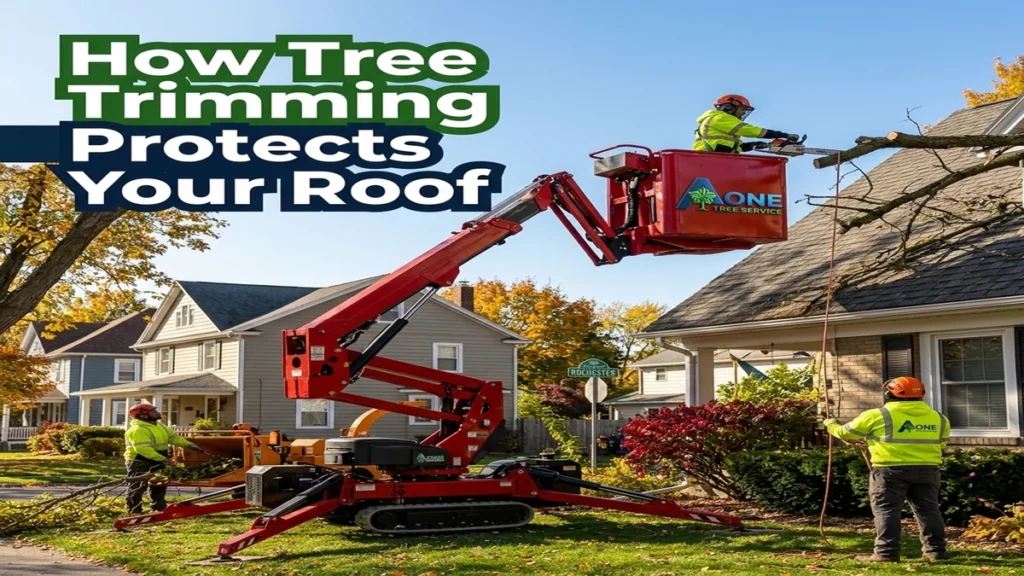
This is not a job to try on a ladder. Cutting a heavy branch above a roof means the weight has to go somewhere, and a limb that drops onto shingles can do the damage you were trying to prevent. Our crews use climbing and rigging gear to lower heavy sections on ropes, so cut wood doesn’t land on your house. For hard to reach trees, a spider lift, the tracked aerial lift that fits through a gate, gets a climber or bucket into a tight backyard without tearing up the lawn. A high capacity chipper turns the brush into mulch on site, and the crew works in orange high visibility gear so you know who is who.
We won’t promise that every limb comes off without a bump, but we plan each cut to protect the roof and anything else below. If you’re deciding between a DIY attempt and a professional, our post on DIY versus professional tree trimming lays out the real risks, including power lines near the roof. Anything that is touching or near a wire should be left to professionals who know how to work around them, and the Trees Are Good site from the International Society of Arboriculture offers consumer advice on hiring one.
When Trimming Isn’t Enough
Some trees are simply too close, too large, or too far gone to save. A leaning tree, a hollow trunk, or a species with weak wood overhanging a roof is a risk that no amount of pruning will cure. In that case, tree removal may be the better call, and we’ll tell you honestly when that’s the case. Overgrown trees can also affect how buyers and inspectors see a property, which we explain in our post on how overgrown trees affect property value. And if a limb has already come down on your house, our emergency tree removal line is open 24/7.
Insurance questions often come up here too. Policies differ, and the Insurance Information Institute is a good place to read up on how homeowners coverage generally treats storm damage. Ask your own insurer about the specifics of your policy.
Frequently Asked Questions
How close can tree branches be to my roof?
There is no single rule, but a few feet of clearance is a common target so branches can’t rub the shingles in the wind. Fast growing trees need more room because they grow back toward the roof quickly.
Can overhanging branches really damage a roof?
Yes. Branches that rub in the wind wear off the protective granules on shingles, and dead or weak limbs can fall in a storm. Leaves and twigs also clog gutters and hold moisture against the roof.
When is the best time to trim trees near my house?
Dead wood can come out any time, and many shade trees are pruned in late winter before buds open. A free on site estimate will help you choose the right timing for the species you have.
Is it safe to trim branches over my roof myself?
It is risky. Working on a ladder above a roof, handling a saw overhead, and dropping heavy limbs that can hit the house or a power line are why most homeowners hand this job to a professional crew.
Does homeowners insurance cover roof damage from a fallen limb?
It often does when a tree damages a covered structure, though deductibles and terms vary. Contact your insurer promptly after any damage and take photos before cleanup begins.
Tree trimming protects your roof best when it happens on a schedule, not after something falls. Call us at (585) 888-9232 or book through our contact page, and we’ll look at your trees, your roofline, and the best way to keep them apart. Our tree trimming page has more on how a visit works, and our storm damage tree removal crews are ready if something has already come down.