
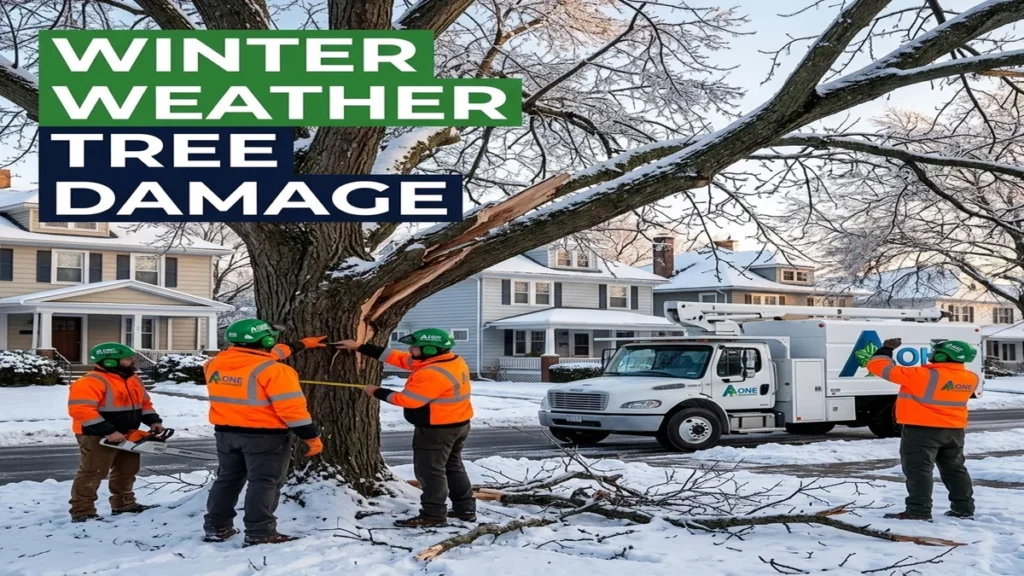
Winter weather damages trees in Rochester through a handful of distinct mechanisms, and understanding them is the difference between catching a problem in March and finding it on your roof in January. A tree that looked solid in October can come through a hard winter with a cracked union, a bent trunk or roots that quietly let go beneath the snow. Lake Ontario feeds our storms, the temperature bounces above and below freezing for months, and the same tree gets hit by heavy snow, then ice, then wind. None of it is dramatic until a limb comes down.
This guide walks through what each kind of winter stress does to a tree, which trees and which spots on a tree are most vulnerable, and what to look for when the snow finally melts.
How Winter Weather Damages Trees: Ice Is the Heaviest Hitter
Ice does more structural harm than almost anything else in a Rochester winter. Freezing rain coats every twig, branch and trunk evenly, and the added weight can be many times what the branch carries bare. Unlike snow, ice does not blow or slide off. It sticks, accumulates and hangs on until it melts, and every hour a tree carries it increases the load on the weakest points.
Limbs usually fail in predictable places. Narrow, V shaped branch unions, where two stems grow tightly together, are weak because bark gets trapped between the stems and prevents a strong wood connection. Silver maples, Callery pears and some other common landscape trees are known for these unions. Trees with dense, fine branching catch more ice than open canopies, and evergreens hold even more because their needles give the ice more to grab.
When an ice storm is forecast, watch the National Weather Service Buffalo office, which covers Rochester, at weather.gov/buf for current alerts. After the storm, stay out from under loaded trees. Branches can release without warning as the ice warms, and shaking them to free the weight usually just makes them snap.
Heavy, Wet Lake Effect Snow
When people talk about how winter weather damages trees, snow gets less blame than ice, but lake effect bands can drop an astonishing amount in a few hours. The snow is often wet and dense, particularly early and late in the season. It loads up on spruce, white pine and other evergreens, bending the branches downward until they crack at the trunk. It piles on deciduous trees that still hold leaves in early snowfalls, since leaves are a place for snow to cling.
Multi stem trees, where two or more trunks rise from close to the same point, are especially exposed. Snow wedged between the stems pushes them apart, and the split often runs down the middle of the tree. Pine and spruce lose their tops or large side branches. Ornamentals such as arborvitae and juniper can be bent over until they never quite stand back up.
If you have evergreens near a driveway, walkway or the house, think about what happens when they let go. Our guide to tree safety tips before heavy snowfall lists what to check before a big storm arrives.
Freeze and Thaw Cycles
Rochester winters rarely hold steady. A cold week gives way to a thaw, then another freeze, and each swing works on the tree in subtle ways.
Frost cracks
On a sunny winter day, the south and southwest side of a trunk can warm up while the rest of the tree stays cold. When the sun goes down, temperatures plunge, the outer wood contracts faster than the inside, and the bark can split lengthwise. You may hear a loud crack on a cold night. Frost cracks often reopen every winter and give moisture and decay a way into the wood. Thin barked trees such as young maples and fruit trees are the usual victims.
Heaved roots and loosened soil
Saturated clay soil expands as it freezes and contracts as it thaws. Over a winter this can lift shallow roots, loosen the ground and weaken a tree’s anchor. A tree that stands well in summer may be sitting in a looser footing by February. Add wind or a load of snow and the root plate can start to tilt. You may not see it until spring, when the lawn around the base looks disturbed.
Splitting and bark damage
Water seeps into small wounds, freezes, expands and widens the opening. Repeat that a dozen times and a small crack becomes a gap. This is why wounds from pruning, lawn equipment or old storm damage deserve a look. Our crews often find that winter did not create the weakness, it simply exposed one that was already there.
Wind, Weight and the Combination Effect
The pattern that worries us most is not any single storm. It is the way winter weather damages trees cumulatively, with each stress making the next one more dangerous.
Any one of these stresses is manageable. The trouble comes from the combination. A tree carrying ice has little give. The branches are stiff and the crown is heavy. Add a gust off the lake, a trunk with a frost crack, and roots loosened by weeks of freeze and thaw, and a tree that has stood for decades may fail. This is also why the same tree can survive three bad winters and fail in the fourth. Damage builds up.
Exposed locations suffer most. Trees on open ground, tall specimens with nothing sheltering them, and trees recently left alone by a neighbor’s removal take the full force. In towns near the lake such as Greece, Irondequoit and Webster, shoreline wind adds to the load. In older neighborhoods like Brighton, Pittsford and East Rochester, big mature trees with a long history of storms have more accumulated weak points.
Road Salt, Winter Burn and Other Quiet Damage
Not every winter injury looks dramatic. Road salt spray and runoff along driveways and plowed streets can damage roots and brown out the needles of evergreens close to the pavement. Winter sun and dry wind can scorch evergreen foliage on the exposed side, a problem called winter burn, which shows up as tan, dry needles in spring. Hungry deer and voles gnaw bark when snow covers other food. These injuries are slower and less alarming, but they lower a tree’s strength and its ability to cope with the next stress.
Signs Your Tree Took Winter Damage
Once the snow melts, give your trees a walk through. Look up and down, and check from more than one side. Here is what we look for:
- Vertical cracks in the trunk or bark that were not there in fall.
- Broken or hanging branches still caught in the canopy.
- Torn bark or stripped patches at the branch collar.
- A new lean, or soil that looks heaved, cracked or pulled away at the base.
- Evergreens with flattened, bent or split tops.
- Late, thin or patchy leaf out in spring on a tree that was healthy last year.
If you find any of these, take photos and get a professional opinion before the tree is carrying a full canopy again. Our guide on signs a tree needs removal helps with the harder calls, and the best time to trim trees explains when pruning can repair some damage.
What You Can Do Before and After Winter
You cannot stop a storm, but you can reduce how much it hurts. In fall, have weak branch unions, deadwood and overextended limbs pruned out, and consider support hardware on valuable trees with a known weak fork. Mulch the root zone, water well before the ground freezes, and keep salt away from roots where possible. Our guide to preparing trees for winter has the full checklist.
During a storm, stay inside. Do not try to knock ice off branches. After the storm, keep people and cars away from damaged trees until they are assessed. For general winter preparedness, Ready.gov has helpful basics.
When winter does leave damage behind, tree trimming can clean up broken limbs and rebalance a crown, and storm damage tree removal handles the bigger failures. For seasonal cleanup specifics, see winter storm tree cleanup in Rochester NY and emergency snow damage.
Frequently Asked Questions
How does winter weather damage trees in Rochester?
Mainly through ice and snow load that breaks limbs, freeze and thaw cycles that crack bark and heave roots, wind on stiff, loaded canopies and road salt near pavement. Damage often shows up after the snow melts.
Which trees are most at risk in winter?
Trees with narrow, V shaped branch unions or multiple stems, like some maples and Callery pears, are prone to splitting. Evergreens can bend and crack under heavy snow, and trees with existing wounds or rot are more vulnerable.
Should I knock snow or ice off my branches?
Generally no. Branches under load are brittle and can snap or release suddenly. A gentle sweep with a broom on reachable, lightly loaded branches is the most you should try.
Can a tree recover from winter damage?
Often yes, if the damage is limited to a few branches or a small wound. Proper pruning helps. Deep splits, large cracks or root failure may be beyond repair.
When should I have my trees checked after winter?
As soon as snow clears and you can see the trunk and lower branches clearly, ideally before spring growth begins. Early checks give you more options and less risk.
Do you offer free estimates for winter tree damage?
Yes. A One Tree Services offers free on site estimates and 24/7 emergency response for storm and winter damage across Rochester and nearby towns.
Knowing how winter weather damages trees is the first step, and a quick professional look is the second. Request a free estimate or call (585) 888-9232, and we will tell you which trees came through fine and which need attention.